MAP
POMPEII AND VALENTIA: TWO CITIES OF ONE EMPIRE
POMPEII AND VALENTIA: TWO CITIES OF ONE EMPIRE
The vast extent of the Roman Empire meant that many of its cities were separated by great distances; even so, they were all connected and shared a single state: Rome. Some cities had existed since ancient times, such as Pompeii (8th–6th centuries BCE); others were built from scratch, such as Valentia, in a previously uninhabited part of Iberian territory.
According to the historian Livy, the colony was founded in 138 BCE by General Decimus Junius Brutus Callaicus to settle veterans of the wars against Viriathus, leader of the Lusitanians (a pre-Roman people of present-day Portugal and Galicia). Around 2,000 settlers are estimated to have arrived, many of them from Campania, the same Italian region where Pompeii is located.
Urban design was one of the great unifying elements of Roman territory. Although Pompeii retained an older, more irregular layout, new cities such as Valentia were planned according to Roman standards: an orthogonal grid organised around a monumental forum.
Both cities share a dramatic common fate marked by destruction. Just over a century and a half before Vesuvius buried Pompeii, Valentia was utterly devastated in 75 BCE during the Roman civil war. As punishment for having supported the rebel commander Quintus Sertorius, General Pompey razed the city after the Battle of the Turia. The devastation was so great that the city took more than half a century to recover, finally rising again under the rule of Caesar Augustus.
From 20 BCE onwards, the city began to be rebuilt. When Pompeii succumbed beneath stones and ash in 79 CE, Valentia was enjoying a period of prosperity and growth. Its forum was monumentally remodelled, its walls were extended and new houses were built, some of them lavishly decorated with paintings and mosaics. Its revival culminated in the construction of an enormous circus covering an area larger than three football pitches and holding 10,000 people. The Roman circus of Valentia stood in what is now the city’s historic centre, occupying a large area between the neighbourhoods of La Seu and La Xerea.
More than two centuries later, with the deep crisis that foreshadowed the end of the Roman Empire, Valentia gradually lost population and political importance. Its market declined and the classical Roman city eventually faded away, finally buried beneath the buildings of the cultures that succeeded it.
Archaeological remains that speak to us
Archaeology is a scientific discipline that extracts historical data from objects and built structures. In every excavation, it strives to work out what lies behind each vessel or each fragment of wall. It is through material culture that historical data are obtained.
Pompeii and Herculaneum are “closed” sites, because a single event froze these cities forever: the eruption of Vesuvius buried them and preserved them in a time capsule. Valentia, by contrast, has continued to evolve to the present day, functioning like a great book of superimposed pages. Its ground has accumulated centuries of continuous construction, destruction, expansion and transformation.
Among the pages of this stratigraphic record, episodes of profound brutality emerge. Excavations in the Roman forum revealed a silent testimony to the civil war of 75 BCE: the remains of fourteen young men aged between seventeen and twenty-two who were violently executed during the conflict.
During excavations beneath Ciutat Vella, parts of the Roman circus built in the 2nd century CE gradually came to light. Structures, gates, remains of the seating and the spina (the central wall dividing the track) were found there. The building occupied what is now Plaça de Nàpols i Sicília and extended across part of today’s Carrer de la Pau and Carrer del Mar.
The fall of the Roman Empire was not the final chapter of this book. The successive civilisations that inhabited this place went on writing new chapters on the same ground, leaving the traces of their legacy beneath the stones.
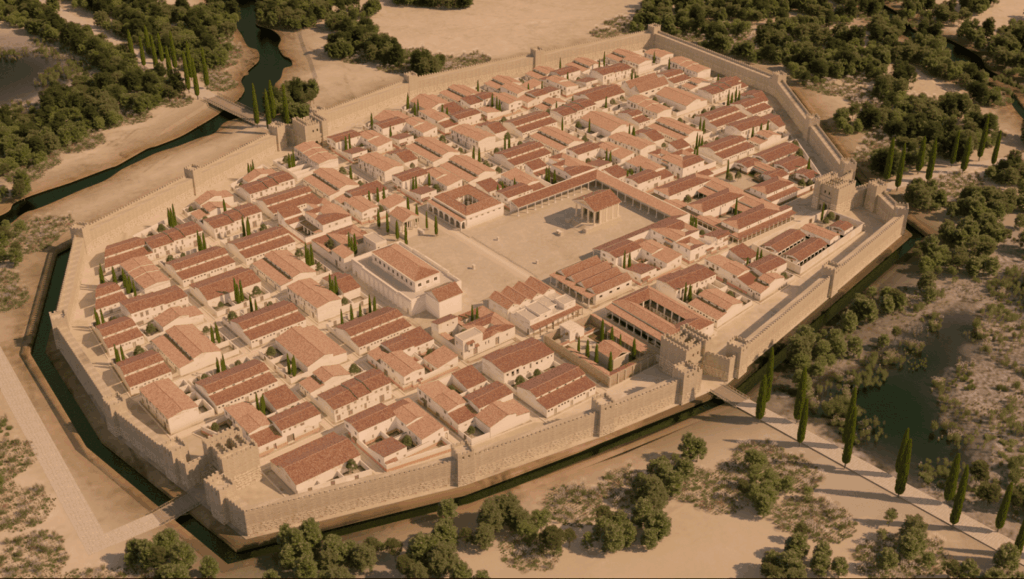
General view of the city of Valentia in the Republican period. Infographic: SIAM, Ajuntament de València
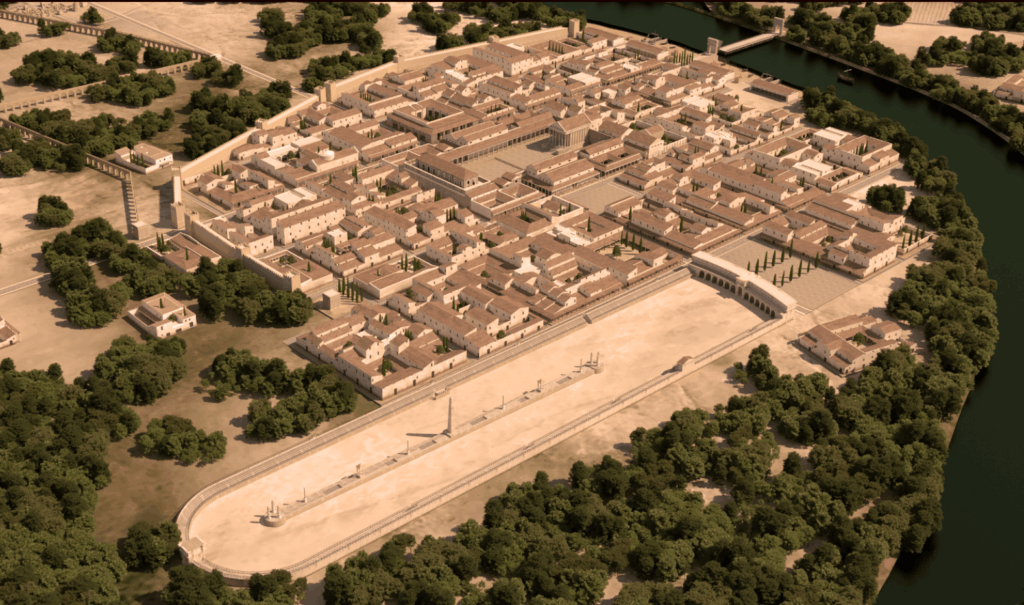
Valentia in the Imperial period. Infographic: SIAM, Ajuntament de València
POMPEII IN VALENTIA
POMPEII IN VALENTIA
Communication between the cities of the Roman Empire was fluid; people and goods travelled by sea and land with ease. The Italian region of Campania, and Pompeii in particular, played an essential role in the development of the art and architecture of newly founded Valentia, as well as in its trade, notably the large-scale import of wine and tableware, dominated by so-called “black-glazed ware”. Thus, the close bond between Valentia and Pompeii was established from the origins of the former until the tragic disappearance of the latter.
Architecture: the baths
Pompeian-style bath buildings, or thermae, spread rapidly across the territories into which Rome expanded. This early model is the one found in the block next to the forum of Valentia, part of whose remains are preserved in today’s L’Almoina Museum.
Dating from shortly after the city’s foundation, the baths of Valentia are of exceptional archaeological value, ranking among the oldest bathing facilities documented anywhere in the Iberian Peninsula. These early baths were characterised by a changing room (apodyterium), a warm room (tepidarium) and a third room for very hot baths (caldarium). The latter reached its high temperatures thanks to a raised floor (hypocaust) through which very hot air from an external furnace circulated.
The arts: decoration
During the city’s heyday, many public buildings and private houses decorated their walls following the same fashion shared with Pompeii.
A fine example of this is the Domus of Terpsichore, whose remains lie beneath the current seat of the Corts Valencianes (Valencian Parliament). The lavish decoration of its rooms preserves successive red panels separated by black interpanels, decorated a candelieri, with plant garlands at the top and dadoes imitating marble.
There are also four female figures portrayed as personifications of different provinces and peoples of the empire, as well as beautiful illusionistic architecture.
The presence of the Pompeian style can be seen even in the smallest details: some of the floral borders found on the walls of Valentia are similar to those in two of Pompeii’s best-known houses, the House of the Vettii and the House of Loreius Tiburtinus.
Trade: amphorae and tableware
The large number of amphorae from the Vesuvius area found in archaeological excavations shows that wine and many other products from Campania were consumed in Valentia.
Tableware from this region is present in the archaeological record. Common ware is abundant: cups and plates used for cooking and eating or for household tasks. Alongside them, there are also lucernae, the oil lamps of the time. Taken together, all these pieces speak of the daily life of the first inhabitants of Valentia.
Objects reserved for special occasions have also been found, such as black-glazed ware. During excavations in Carrer Historiador Chabàs in the mid-1990s, the remains of a banquet held to the north of the forum shortly after the city’s foundation were discovered. Inside a large pit lay the tableware used in a ritual meal. In total, 44 vessels were recovered, most of them from Italy, such as black-glazed cups from Naples and Cales —towns near Pompeii—, as well as cooking ware and wine amphorae. Another similar ritual offering was also discovered during excavations in Plaça de L’Almoina.
Alongside the pottery were the bones of several sacrificed young animals —a sheep or goat, a bull, a pig and a horse—, as well as snails and seashells. All of these formed part of the offerings required for that ritual feast, which symbolically marked the foundation of Valentia.
After the eruption of Vesuvius, Valentia readjusted its trade networks with other areas of the empire, such as Latium, Rhodes, Tunisia, southern France and the rest of Hispania. With their fields and workshops destroyed, Pompeii and Herculaneum ceased to be the important economic centres they had been, and Valentia was among the cities that filled this gap, exporting amphorae of local wine, textiles for clothing and for repairing ships’ sails, as well as common and storage ware for the thousands of families displaced to other cities in Campania.
Movement of people
The magnificent network of Roman roads allowed citizens to travel freely, so the presence of people from Campania in Hispania was common. Archaeology bears this out with the case of Publius Fulvius Asclas, a native of Pompeii, about whom we know neither his trade nor other details of his life, but we do know where he died. The inscription on a funerary altar found at the archaeological site of Tossal de Manises (Lucentum), in present-day Alicante, reads:
P(UBLIUS). FULVIU[S]
ASCLAS P[OM]
PEIAN(US) ANN(ORUM)
XXXII. H(ic). [S(itus) E(st)]
(Here lies)
PUBLIUS FULVIUS ASCLAS
POMPEIAN
AGED 32
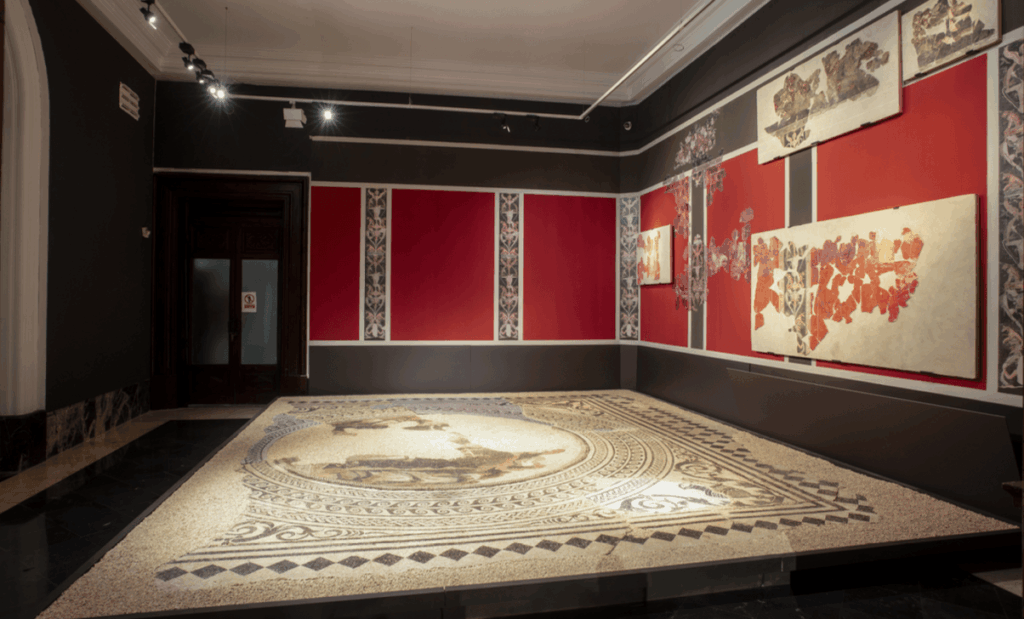
Reconstruction for the exhibition “75 anys, 75 peces”. Image: SIAM, Ajuntament de València. Photo: P. Alcántara.
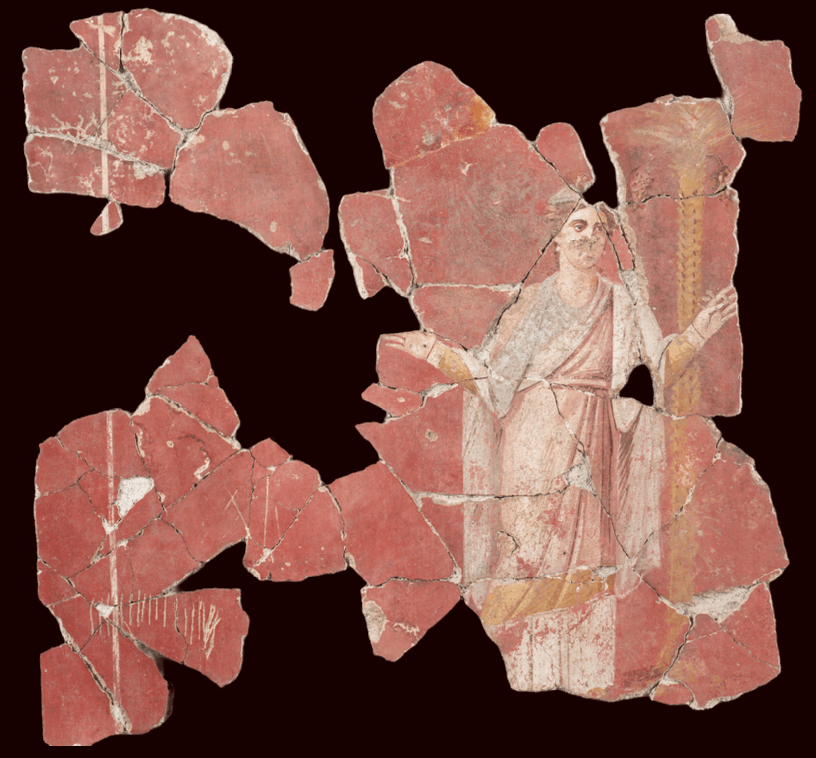
Allegorical female figure. Image: MHV, Ajuntament de València. Photo: P. Alcántara.
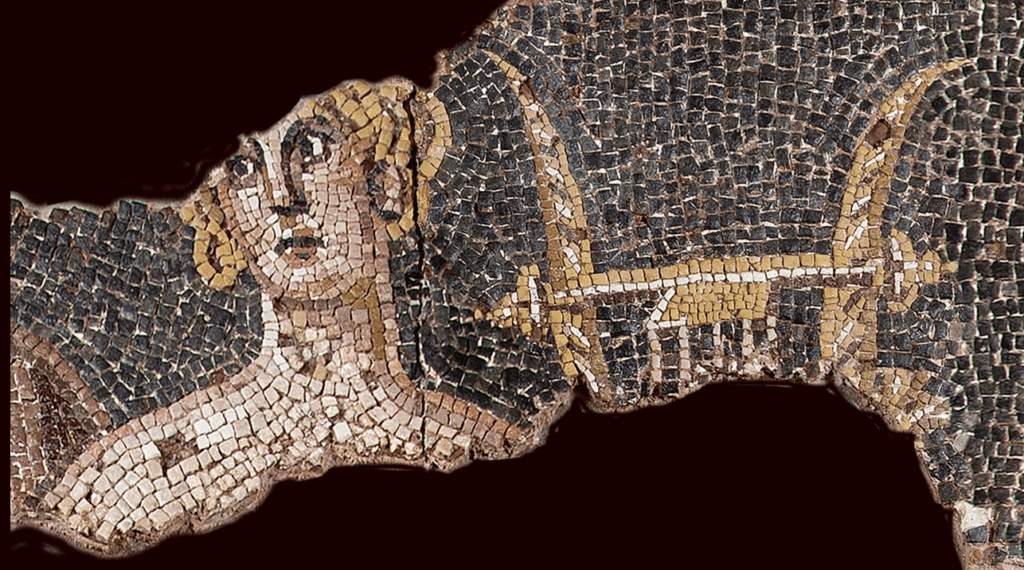
Face of Terpsichore, muse of dance, depicted on the central floor of the Domus. Image: SIAM, Valencia City Council.
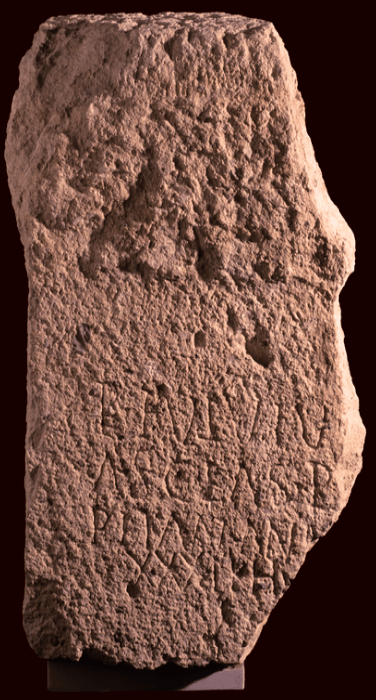
Funerary altar inscription. From the Technical Archive of MARQ, Archaeological Museum of Alicante.
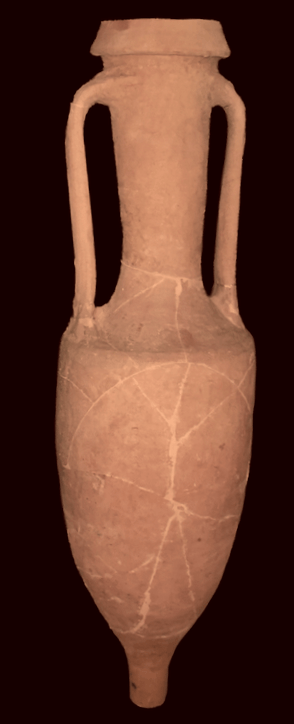
Italic amphorae. L'Almoina. Image: SIAM, Ajuntament de València
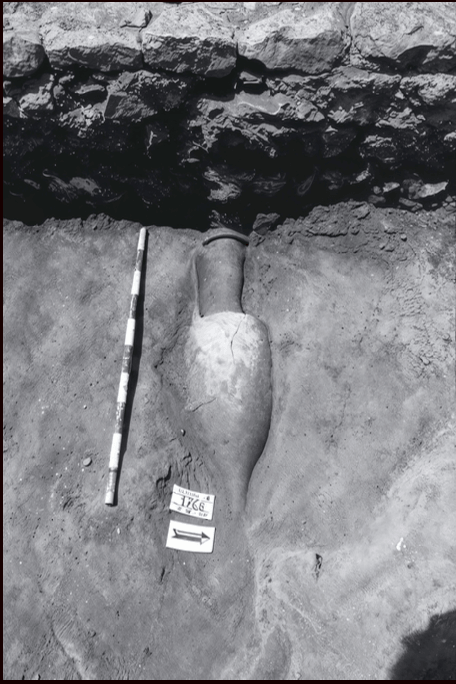
Italic amphora during excavation. L'Almoina. Image: SIAM, Ajuntament de València
POMPEII: MYTH AND LIFE BENEATH THE VOLCANO
MYTH AND LIFE BENEATH THE VOLCANO
The most famous ancient city in history, destroyed and buried by the eruption of Mount Vesuvius in the year 79 of our era, is the protagonist of this exhibition, conceived to make us feel the thrill of its vitality almost 2,000 years after the tragedy that turned it into a legend.
Its dramatic disappearance, as well as its striking rediscovery, has been a constant reference in popular imagination, and its myth has lived on for centuries, even prevailing over its own history. Literature and painting first, and later photography, cinema, and television, have established Pompeii as one of the most recognised cultural myths worldwide. A unique role has been played by the novel The Last Days of Pompeii, written by Edward Bulwer-Lytton in 1834, and in these last 190 years it has remained the main source of inspiration for creators and artists who have approached Pompeii, maintaining its relevance as a popular reference in today’s audiovisual culture.
This exhibition, conceived on solid archaeological and historical research foundations, also shares the same creative narrative spirit that perpetuates every myth from generation to generation. Updating it by deploying state-of-the-art technologies at the service of human creativity and dissemination, it invites each person’s curiosity to explore the deepest knowledge of the life of this unique city under the volcano. At the same time, the exhibition also aims to showcase the impressive work of the Archaeological Park of Pompeii in the recovery and enhancement of the archaeological site.
Let’s delve into extraordinary places where we will discover that Pompeii’s past preserves all its vitality. After this visit, you’ll see Pompeii in a different light.
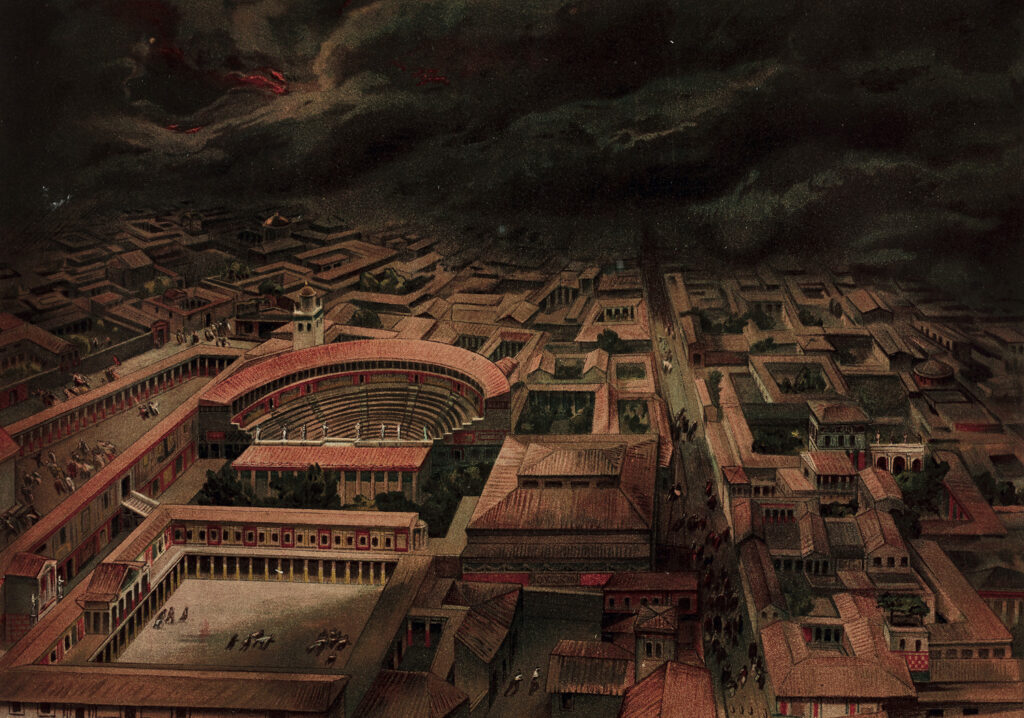
Pompeii succumbing to the forces of nature of Mount Vesuvius.
ORIGIN AND BIRTH OF POMPEII
ORIGIN AND BIRTH OF POMPEII
The settlement originated on a plateau in the Campania region to control the valley of the Sarno River, where a bustling port was situated at its mouth. The city was located 30 metres above sea level on a mass of Vesuvius’ lava. It grew in relation to the coastline as a prime location and a crossroads, very close to Naples. This prosperous territory, abundant with fertile land, flourished through its agriculture, hunting, fishing, livestock farming, vine cultivation, and the export of wine.
In the 6th century BCE, the true urban birth of Pompeii occurred. The city solidified as a stable, supplied, and fortified habitation centre. Its population was diverse, primarily consisting of Etruscans –an Italic people from the Tuscany region– Greeks, Romans, and local Samnite tribes. The involvement of these Samnite peoples and their expansion movements led to Rome’s intervention in southern Italy, gaining hegemony over the entire Campanian territory. Hence, Pompeii, as an “ally,” became part of the political organisation of the Roman Republic, rebelling until it secured the same rights as the capital of the state.
After the siege by the troops of Lucius Cornelius Sulla, the city surrendered and from 80 BCE, it became a Roman colony named Cornelia Veneria Pompeianorum. During this time, its 20,000 inhabitants spread over an area of about 60 hectares, surrounded by walls. The heart of its prosperity was located in the active maritime and commercial port of the city. History marked the features of Pompeii in 79 CE as one of the most advanced cities of antiquity –open, cosmopolitan, and prosperous. We’ll have the opportunity to explore its character in a way that has not been seen before. In addition, thanks to the account of the Roman writer and lawyer Pliny the Younger, through his Letters, we will discover firsthand his description of the eruption of Vesuvius and the astonishing narrative of Pompeii’s destruction by the forces of nature.
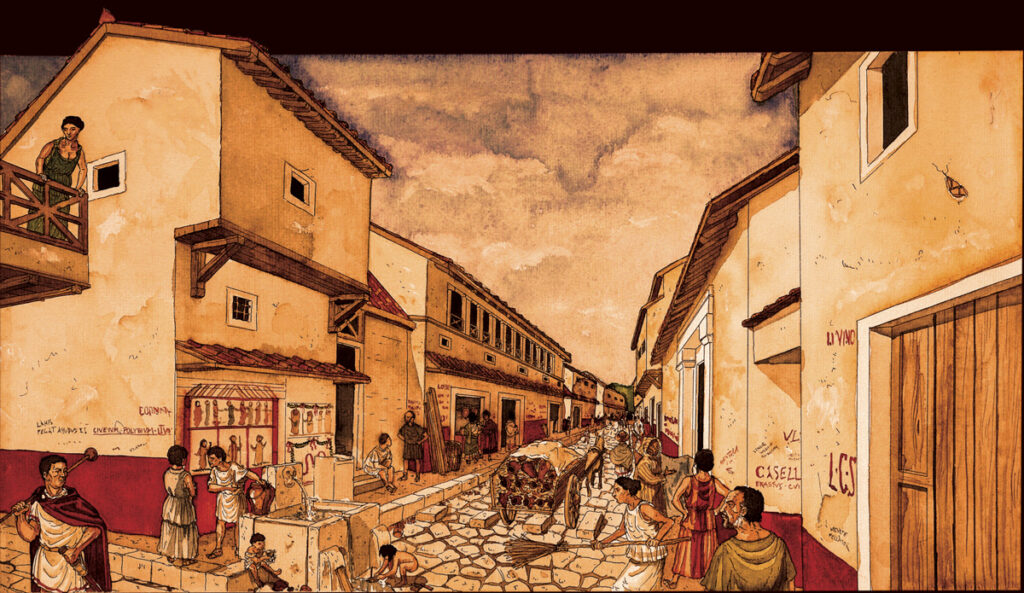
Illustration of a reconstruction of premises open to the public on the Street of Abundance.
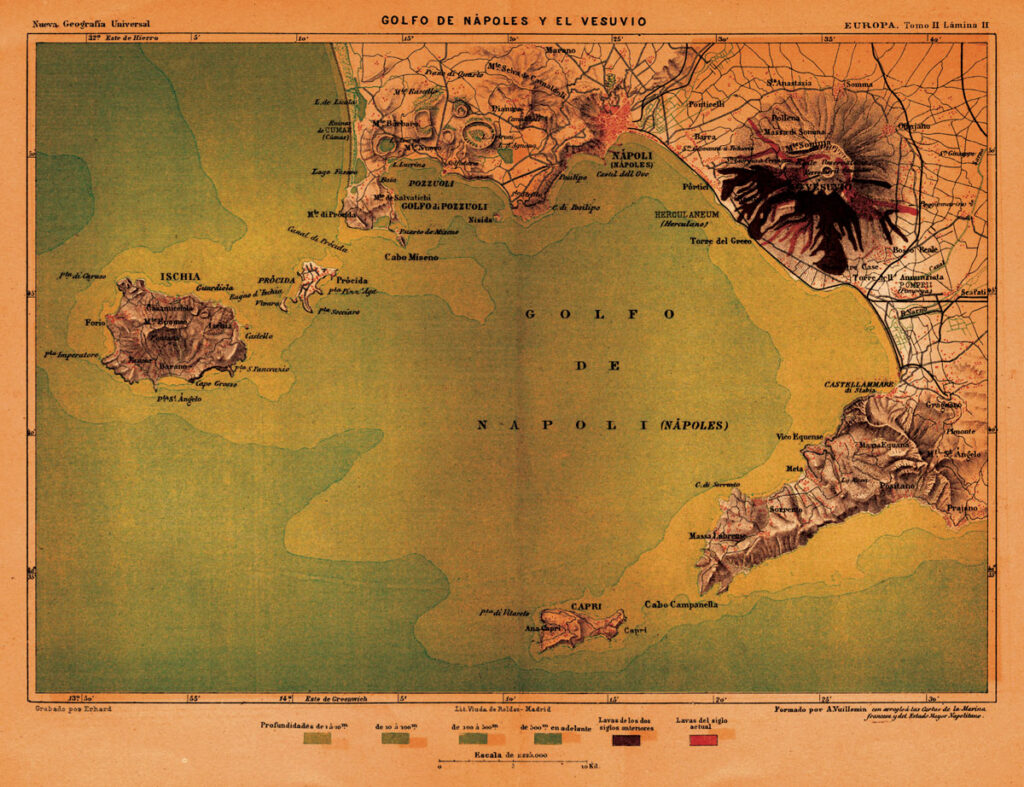
19th-century map of the Gulf of Naples, Mount Vesuvius, and the locations of the cities affected by its eruption.
EXPLORING THE CITY
EXPLORING THE CITY
Pompeii flourished during the dominance of the Roman Empire, with public buildings and grand houses of important families being constructed under the emperors Augustus (27 BCE – 14 CE) and Tiberius (14-37 CE). It is estimated that Pompeii had around 20,000 inhabitants, including 12,000 free citizens and 8,000 slaves.
The Forum was the major public and institutional square of the city, where most political activities and business transactions took place. On Saturdays, the bustling atmosphere of the city moved to the markets, where merchants, moneylenders and auctioneers offered their merchandise.
The baths (thermae) were the place for daily enjoyment of the relaxing pleasure of water. It was a true hub of the city’s life and personal care accessible to everyone, even the humblest.
The baths featured a variety of baths, porticos, gardens, shops, gymnasiums or massage rooms, and even a library.
The thermopolium was a small and appealing tavern where people could eat and drink hot food. Most citizens took their midday meal there. It had a counter with containers of various products to be eaten whilst standing or sitting in interior rooms. This meal usually consisted of bread, cold meat, vegetables, and fruit, accompanied by wine.
Sometimes, forbidden games like dice and knucklebones were played in the backroom.
Gladiator combat was the major social spectacle of the city. Pompeii’s amphitheatre accommodated 20,000 people enjoying violent fights to the death, a display of unbridled passion both in the arena and the stands. These fighters, originally slaves or prisoners, became professional soldiers, gaining popularity and wealth.
They were differentiated by their place of origin, known by names like Samnites, Gauls, or Thracians, among others, as well as by the type of weaponry they used. The theatre was one of the most popular shows, often held in the evening by torchlight. The first permanent theatres were built during the time of Augustus. There were three types of plays based on tragedy, comedy, or satirical drama. The building consisted of three parts, just like today: scaena (stage), orchestra (semicircular area at the foot of the stage), and cavea (audience seating). The orchestra was reserved for magistrates and members of the senatorial order. Attending the theatre was a major social event. Pompeii had two theatres: the Teatro Grande, which could accommodate 5,000 people, and the Odeon, with 1,000 seats and a roof, where concerts and recitals were organised.
The city had numerous temples, but the most important ones for the people of Pompeii were dedicated to Jupiter, Juno, Venus, Isis, Apollo, and Mars. Romans believed that all aspects of life were controlled by the gods, and the annual calendar was rife in festivities to honour them.
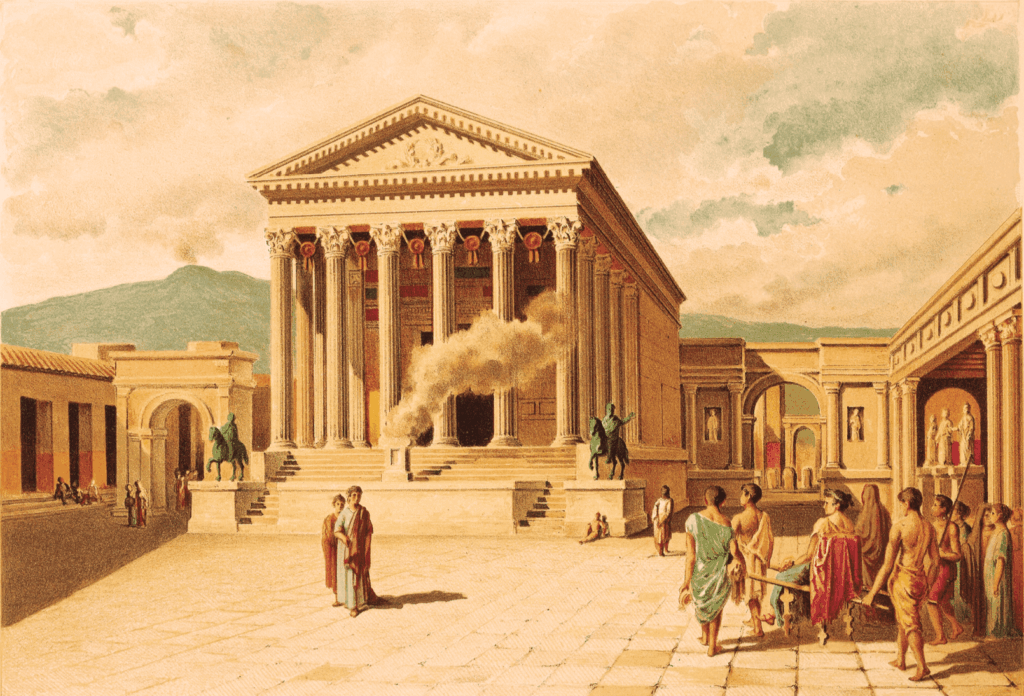
View of the Forum and the Temple of Jupiter on an illustrated plate.
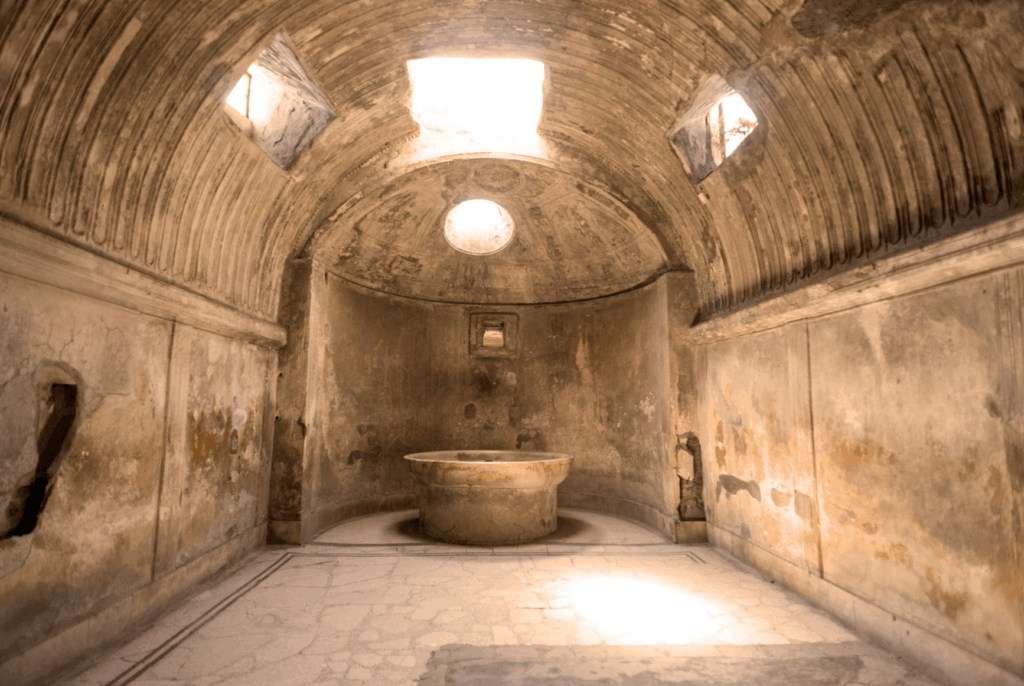
Photo of the current state of a room in the Forum Baths.
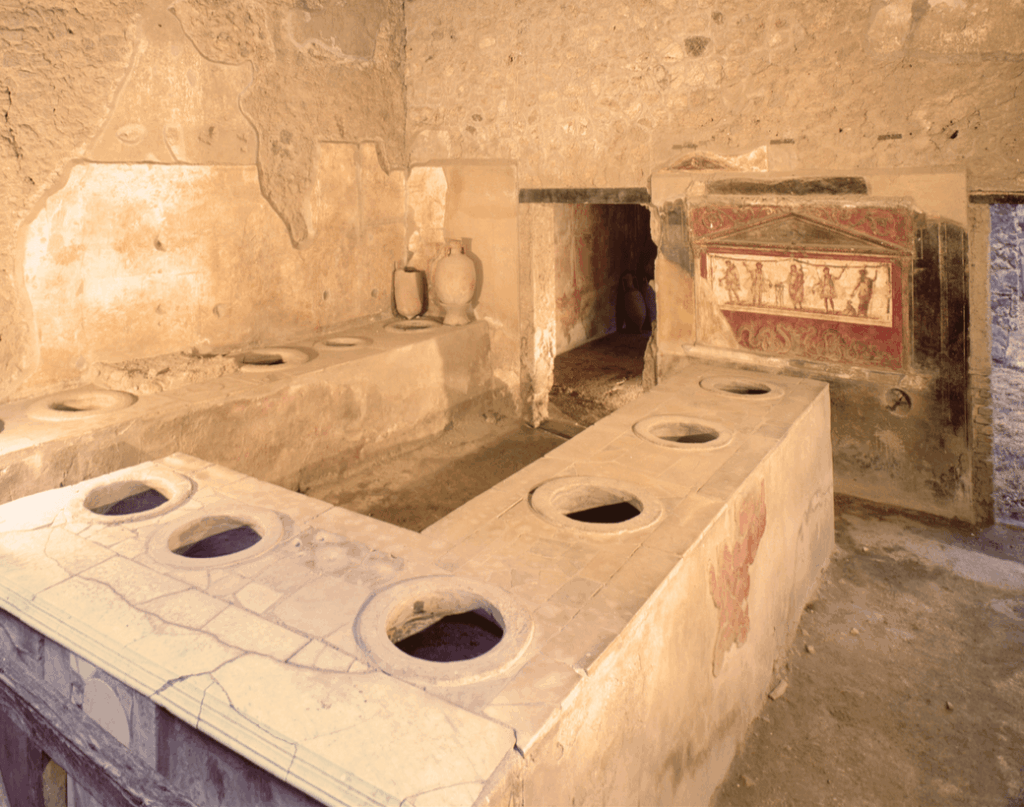
Photo of the current state of a tavern or fast food “food truck” in the city.
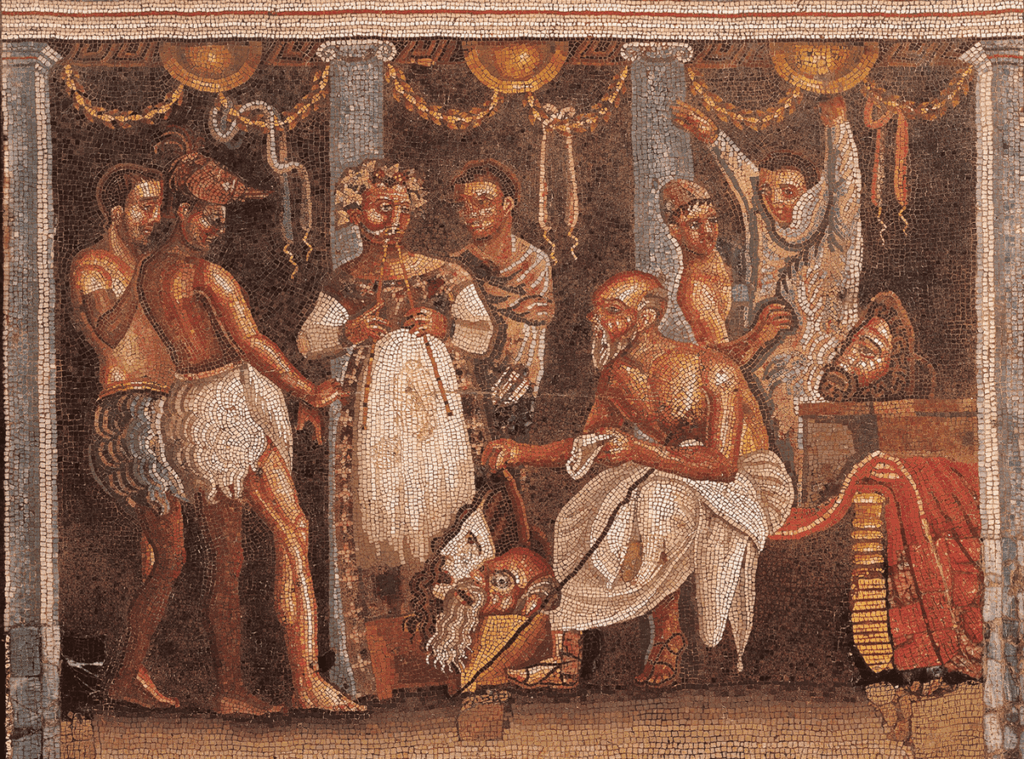
Mosaic depicting the staging of a performance in a theatre, House of the Tragic Poet.
A DAY IN THE DOMUS
A DAY IN THE DOMUS
The Roman domus or house was constructed around a large courtyard, the atrium, which opened into several rooms and was adorned with grand mythological scenes. In the centre of this courtyard, the roof was open, and underneath there was a basin that collected rainwater, stored in a cistern. Beyond the atrium, there was a garden often shaded by a portico surrounded by columns. Some houses had a small kitchen, often connected to a latrine, in addition to closets and various household objects. Originally, they were painted in vivid colours, from the walls to the columns.
Similar to today, the week was made up of 7 days, each dedicated to one of the seven planets they knew, which, according to their belief, ruled the Universe. Let’s delve into the details of how a typical day unfolded.
They woke up early at around 8 in the morning, as the voices of workers and schoolchildren were heard from the early hours. They began with personal grooming –men would tend to their beards and hair at home or at a barber shop. Women would adorn themselves and pay special attention to their hairstyles, often influenced by the current empress’s hairdos. The dressing style varied little between the sexes and was primarily influenced by the fashions of each era.
They would have a light breakfast standing up, consisting of bread spread with garlic or salt, always accompanied by some cheese, honey, and fresh fruit.
Children under 7 years old received lessons at home from their parents or a tutor, where they learned the basics: reading, writing, arithmetic, and music. From that age until around the age of 12 they would attend a school to continue their education.
The majority of the day was dedicated to household maintenance and chores, overseen by the women. After the workday was over, activity shifted back to the houses, where dinner became the focal point of social and family life.
Both men and women would remove their footwear upon entering the house and put on sandals or slippers. It was considered impolite to enter a friend’s house wearing shoes, so a slave would often offer the guest a pair of sandals.
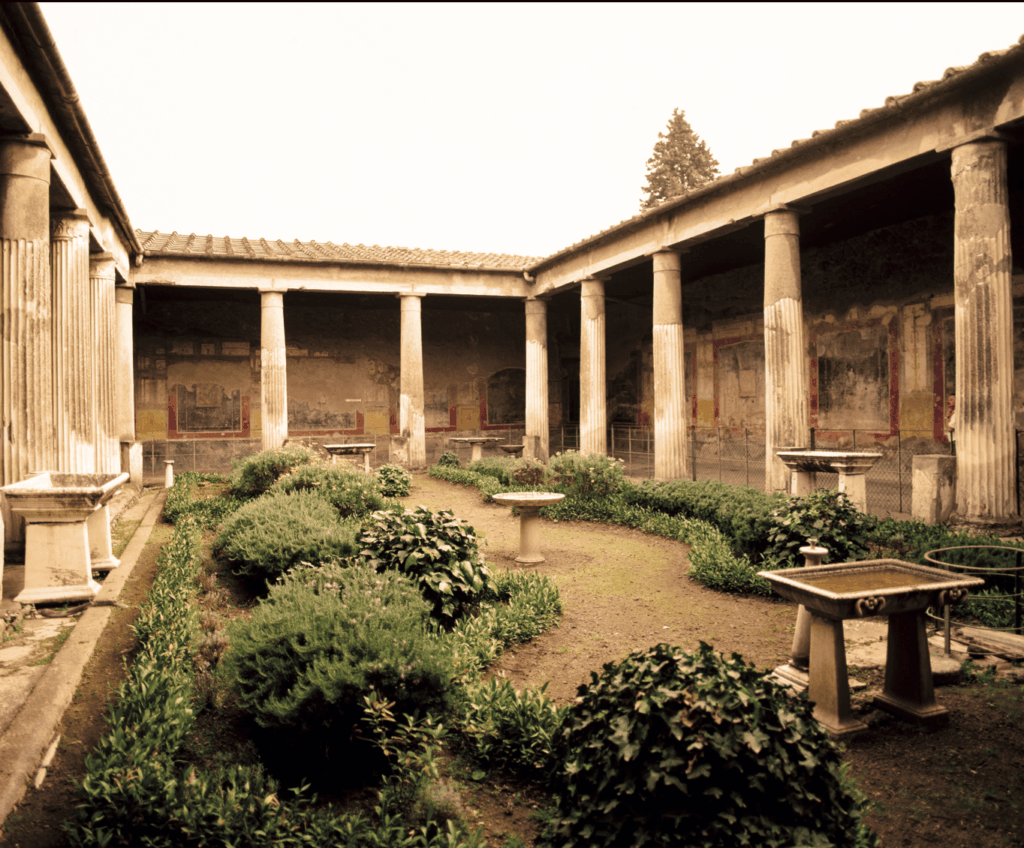
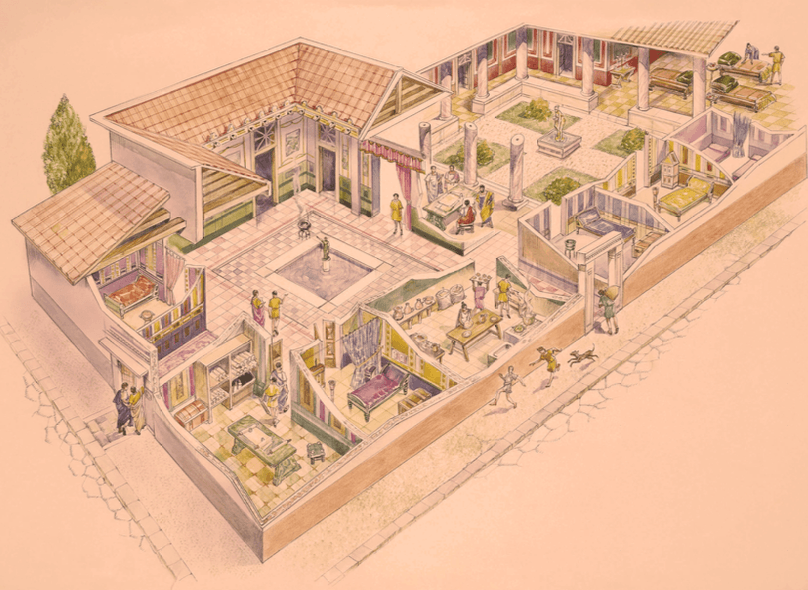
Reconstruction of a private residence with all its luxury rooms.
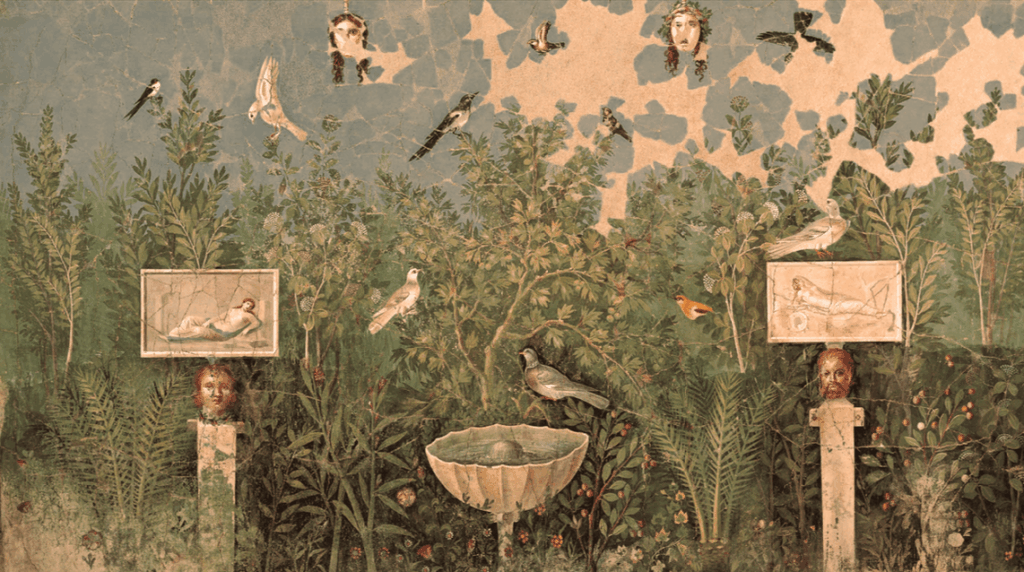
Fresco from the House of the Golden Bracelet featuring a wall painting with birds and floral motifs typical of Pompeian decoration.
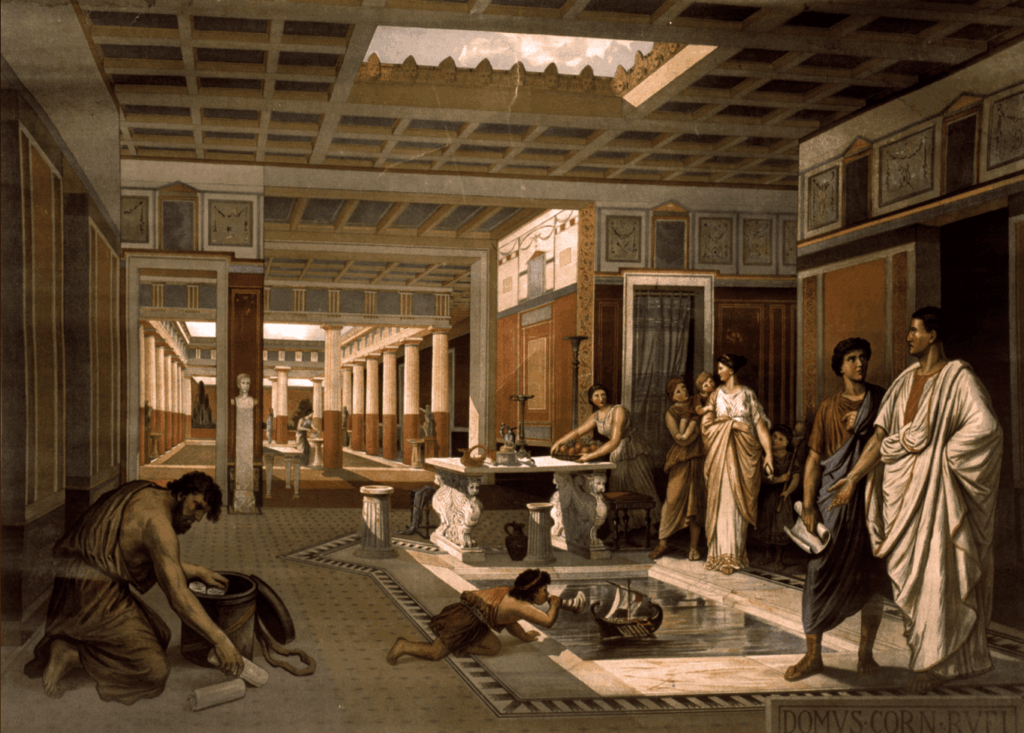
Scene of everyday life inside the house.
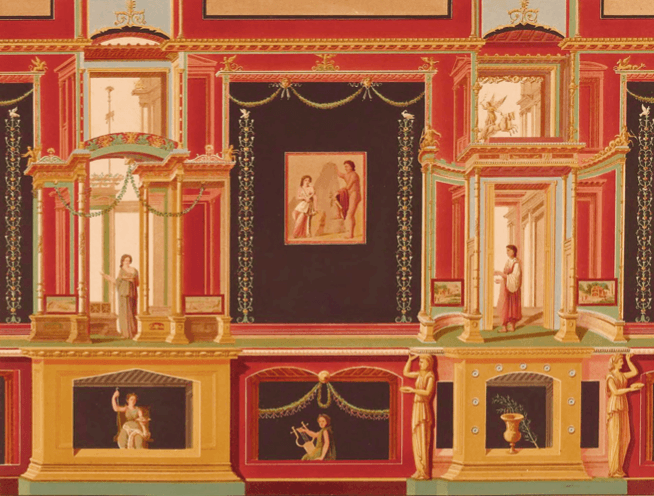
In Pompeian house decoration, architecture was used to create illusory, surreal spaces, alternating with large “narrative” paintings of mythological themes.
THE PLEASURE OF REAL DINING
THE PLEASURE OF REAL DINING
For the Romans, the space and time dedicated to culinary pleasure were truly sacred. After two light meals of the day, sometimes standing and hurried, the only proper meal was the dinner known as cena. This important evening event, organised in the domus, was a grand banquet that could last until midnight or even until dawn.
It took place in a special room of the house, the triclinium, the traditional Roman dining room consisting of three long couches where the hosts and their guests reclined whilst conversing in leisurely fashion. These banquets were a symbol of social superiority and elegance, with attendees dressed in luxurious attire.
Food was eaten with the hands as forks didn’t exist yet, so slaves were always nearby with water jugs for handwashing. A Roman dinner consisted of at least seven courses: appetizers, three main courses, two roasts and dessert.
As for drinks, the dinner would start with a welcome cup.
Following the appetizers, they drank a wine mixed with honey called mulsum. Then, between courses, they drank wines from various regions. Greek wines were the sweetest, those from Marseille were smoother, and Spanish wines were the strongest. Wines from Falernum and the Vesuvian area were some of their favourites. These wines were always drunk mixed with some water.
After dinner, the commissatio or ceremonial drunkenness took place. This was achieved by downing cups of wine in succession, following the lead of the person presiding over the event. It marked the end of the dinner and of the night.
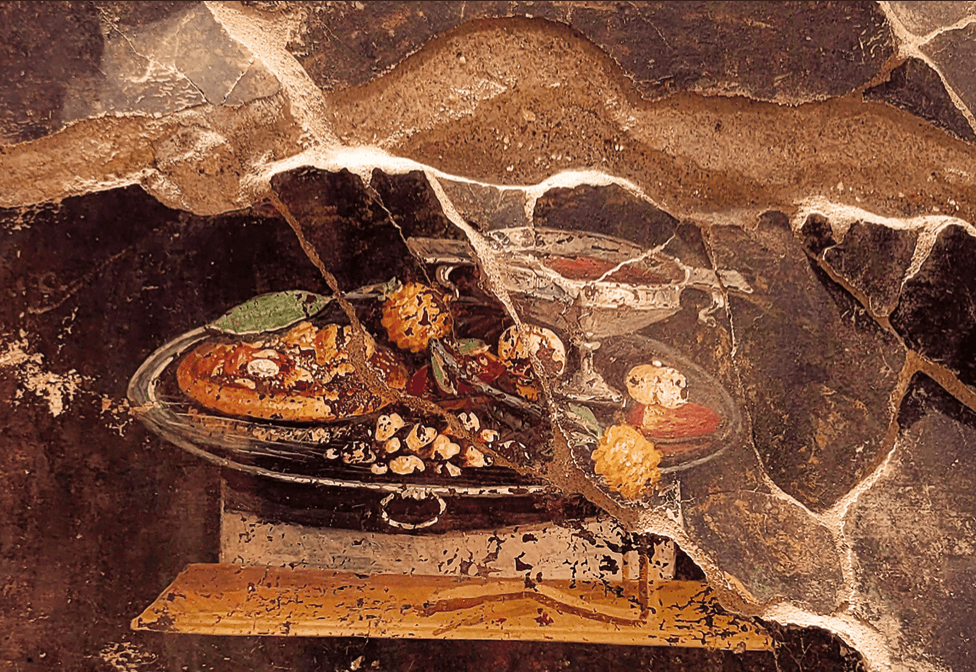
Recently discovered painting depicting food that could be a precursor to pizza.
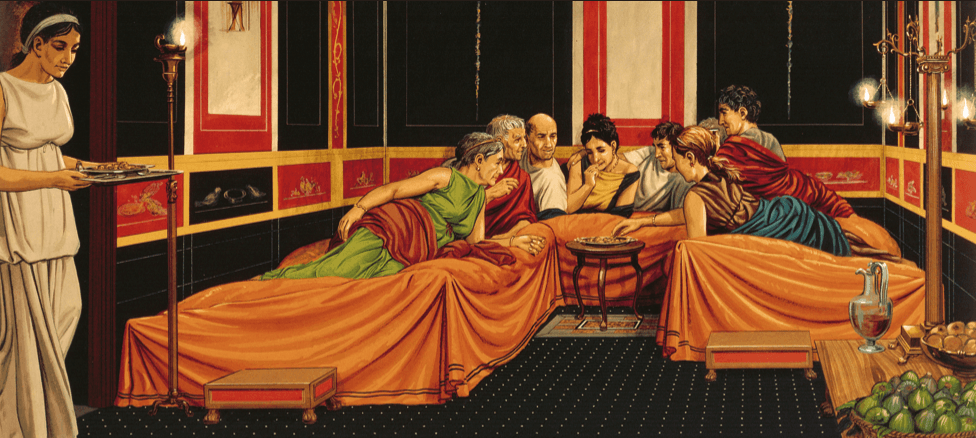
Group of people in the triclinium, chatting and enjoying an evening.
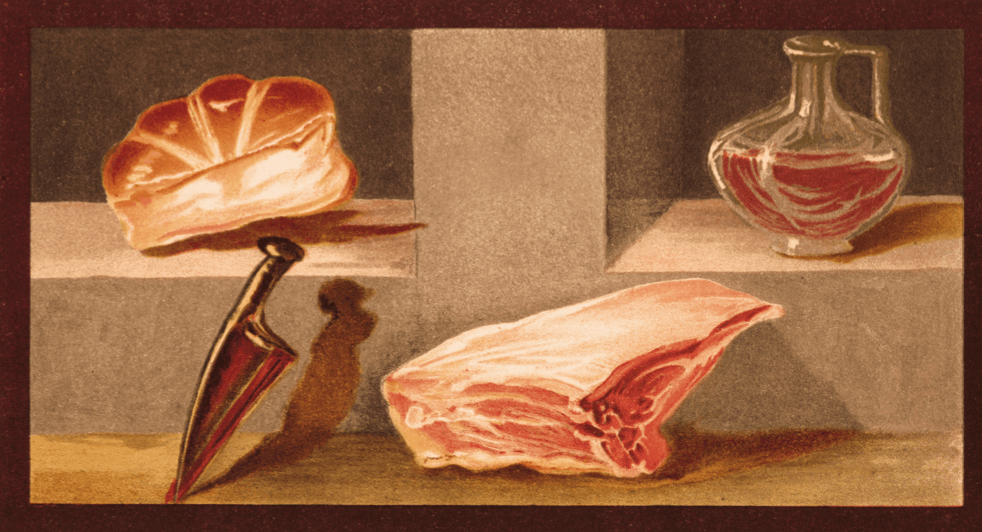
Staple foods in the life of a Pompeian: bread, meat, and wine.
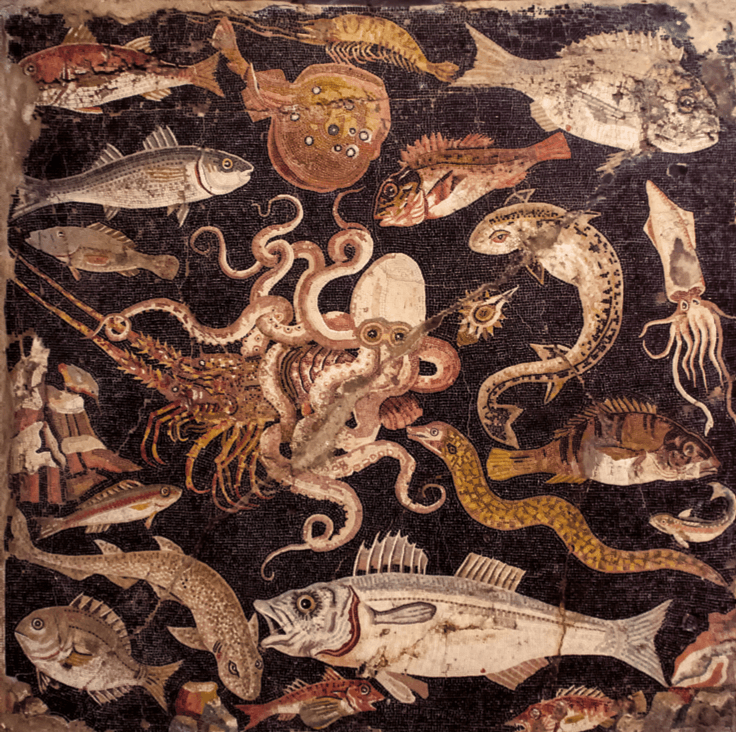
Showcase of the most cherished Mediterranean marine species consumed by the Pompeians.
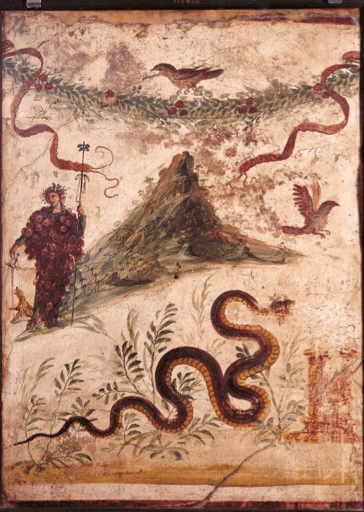
Depiction of Bacchus transformed into a cluster of grapes, perhaps protected by Vesuvius before its eruption.
REAL ARTIFACTS AND REPLICAS
REPLICA OBJECTS
- Dancing Faun
Bronze reproduction
This bronze statue of a dancing faun is similar to one found in the atrium area of one of Pompeii’s most famous houses which is now, in honour of this being, known as the House of the Faun. The house contains one of the most spectacular polychrome mosaics of the ancient world, representing the battle of Alexander the Great against the Persian king Darius.
- Bacchus Terracotta
Terracotta reproduction
Recognised as the god of wine and the grape harvest, Bacchus was an important deity of the classical Greek and Roman world. He is often depicted with his head surrounded by vine leaves and grapes. The Bacchanals were the festivals dedicated in his honour. He was also considered the protective god of theatre and the performing arts, with the divine mission of warding off concerns through music and poetry, showing the importance of theatre as a sacred ritual and manifestation of enormous social importance linked to celebration, fertility and artistic inspiration.
- Faun with pipes statue
Bronze reproduction
This statue is based on a drawing found during excavations of Pompeii. These bronzes were part of the Grand Tour collection, statuettes produced in the 1880s for tourists visiting Europe by mainly Italian and French sculptors.
The faun or satyr is a male figure with thick hair and beard that represents a mythological creature halfway between human and animal. The pose seems to convey a dancing movement while playing a melody on the aulos, a type of double flute – the predecessor of the clarinet – of Phrygian origin and linked to the orgiastic rites dedicated to the gods Bacchus and Cybele. Despite its rather strident sound, it was one of the most used instruments, along with the lyre, and is present in a variety of manifestations: from rituals to parties and military events.
- Comedy and Tragedy mask
Terracota reproduction
Reproduction of a 1st century Roman mosaic depicting the masks of tragic theatre and comedy from the excavations of Pompeii and Herculaneum 1st century AD, Capitoline Museums, Rome.
One of the most popular representations in the theatre world combines comedy, drama and tragedy. These characters eventually became known by their own names. This piece includes Melpomene, who represents tragedy, while Bacchus embodies comedy. Theatrical masks covered the entire face and were often provided with false hair, allowing the same actor to play several characters. Their marked expressions showed the characterisation from a distance and their design amplified the tone of voice.
- Flora
Botticino marble reproduction
Reproduction of the representation of Flora from a fresco from Villa Arianna – found during the archaeological excavations at Stabiae, the original of which is kept in the National Archaeological Museum in Naples. On this renowned marble tile, the nymph Flora is represented delicately collecting flowers in her basket. As a deity, she received great devotion linked to the protection of flowering and wheat, and in her rituals it was necessary to participate in brightly coloured dresses that imitated the diversity of tones of nature.
The fine Botticino marble is recognised for its beige tone with brown veins and subtle fossils on the background colour. The marble comes from the surrounding hills of Brescia and has been recognised for centuries as an exceptional material.
- Medusa plate
Bronze reproduction
In Greek mythology, Medusa was a monstrous female creature, the most famous of the Gorgon sisters and the only one who was mortal. With just her gaze, she turned anyone who looked at her into stone. She is well known for the story of her death, caused by the hero Perseus, who beheaded her with the help of the gods Hermes and Athena and used her head to defeat his enemies. For this reason, the image of Medusa’s head was used as a symbol of protection and defense against evil at the entrance to temples and palaces.
Option 1. Short text: make both cards
- Stele from Pompeii
Limestone reproduction
Size: 55cm
A stele is a monolithic monument made of stone or marble with inscriptions in the form of a tombstone or pedestal that is normally erected above the ground and has a funerary, commemorative, religious or geographical function. This piece likely served to identify a location connected with Roman shows.
Option 2. Large text: make both cards
- Stele from Pompeii
Limestone reproduction
A stele is a monolithic monument made of stone or marble with inscriptions in the form of a tombstone or pedestal that is normally erected above the ground and has a funerary, commemorative, religious or geographical function. This piece likely served to identify a location connected with Roman shows.
Epigraphic transcription in Latin:
C(aius) Quinctius C(ai) f(ilius) Valgus
M(arcus) Porcius M(arci) f(ilius) duovir(i)
quinq(uennales) colonia<e=I> honoris
caus{s}a spectacula de sua
pe<c=Q>(unia) fac(iunda) coer(averunt) et colon{e}is
locum in perpetu<u=O>m deder(unt)
Literal translation:
According to Cooley, this translates as:
“Gaius Quinctius Valgus, son of Gaius, and Marcus Porcius, son of Marcus, quinquennial duumvirs, for the honour of the colony, saw to the construction of the amphitheatre at their own expense and gave the area to the colonists in perpetuity”.
See Cooley, A. and M.G.L., 2004. Pompeii: A Sourcebook. London: Routledge, p. 21, B10.
The meaning of the phrase within the historical context:
This plaque belonged to the Amphitheatre of Pompeii, built around 70 BC, and was the first stone building with a capacity of about 20,000 spectators, built 150 years before the Colosseum in Rome. It was built by the magistrates of Pompeii, Gaius Quinctius Valgus and Marcus Porcius, quinquennial duumvirs of the city, in honour of the colonists, the new roman inhabitants of Pompeii, who had settled a few years earlier around the original core of the city, accelerating its growth and expansion. This plaque reflects the transformation of Pompeii into a new Roman city after its founding period by the Oscians.
In the text it is mentioned that the two magistrates built the amphitheatre at the ‘expense’ of their economic resources for the honour of the colony, but the reality was usually different, with honourable exceptions, because these constructions were usually paid for with public funds, but it was interesting to add this nuance being used in order to gain popularity.
See Beard, M. Pompeii: History and legend of a Roman city. Barcelona: Editorial Crítica.
- Venus and Mars Fresco
Fresco reproduction
The city of Pompeii has always been identified with the goddess Venus; the inhabitants worshipped her as a symbol of the generating power of nature. For this reason, there were numerous representations of the goddess spread throughout the houses of Pompeii. Here we see the loves of the gods Mars and Venus widely represented in the city. In this fresco, the semi-naked and jewelled feminine divinity predominates, while some happy lovers play with the weapons of the god of war.
- Slave shackles
Iron reproduction
Pompeii, like all Roman societies, had very differentiated and rigid class structures, in which social advancement was very difficult – if not impossible. The lowest class was made up of slaves who did not have any rights and did a large number of daily tasks for their masters. The freedom of some was only possible because others were enslaved, which is why they considered slavery a necessity. Here we see an example of slave shackles.
Body Cast Set
Figure cast man
Plaster reproduction
The bodies of those victims that the volcano surprised inside their homes remained in the same position as when the pyroclastic flow hit them and, being covered by layers of calcified ash, the shape of their bodies was preserved even after the decomposition of the biological material. This is the case of this dramatic and emotional figure of a hidden crouching man.
Body Cast Set
Plaster reproduction
This set of plaster pieces are 3D printed copies of originals recovered in the Pompeii excavations. Using the molds technique invented by the director Giuseppe Fiorelli, copies were made after applying plaster casts in the voids resulting from the dissolution of the human bodies themselves as a cast. During excavations, the remains of more than a thousand victims of the eruption of 79 AD have been found. To date, almost 400 bodies have been recovered under the city’s pumice stone and nearly 700 among the solidified remains of the volcano’s pyroclastic flow.
Body House of Loreius Tiburtinus
Plaster reproduction
This figure, a copy of the original found in the House of Loreius Tiburtinus, is another impressive example that reproduces the final pose of a Pompeian who died in the eruption. Its position allows us to empathise with the tragedy and the moment of pain that was frozen forever. These examples connect us across time with the catastrophe and the moment when the life of a city was completely cut short.
ORIGINAL ARTEFACTS
Figure of Priapus
1st century CE
Marble
This figure represents the god Priapus, associated with fertility and agriculture. Priapus is often depicted as a bearded man with a large phallus symbolising the fertilising force of nature. He was revered as the protector of crops, gardens and fields. He also became a popular figure in Roman erotic art and Latin literature.
Set of rein rings
3rd century CE, 2nd century CE
Bronze
A set of rein rings belonging to a Roman quadriga cart. Made in bronze with geometric shapes and floral detail. A fine example of the artistic detail put into a practical piece for a horse-drawn cart.
Massive head from Osuna
1st century CE
Marble
This piece – designated as a Cultural Interest Asset – was part of a set of sculptures discovered in 1903 in the archaeological area of the ancient city of Urso, present-day Osuna (Seville). It has been interpreted as an idealised portrait of Lucius Caesar, following models of Polykleitos, carved in white marble, possibly from Greece, with immense proportions, showcasing the Roman Imperial Cult in the city of Urso in the early 1st century CE. This piece is thought to have belonged to a public space in the colony, possibly located in the forum.
Lucius was the grandson of the Emperor Caesar Augustus, who appointed Lucius as his heir along with his brother Gaius. Both were tremendously popular in their time and their unexpected deaths in 2 CE and 4 CE, respectively, had a major impact. Lucius died in Hispania during an excursion to gain military experience.
Doll representing the goddess Aphrodite
2nd century ─ 3rd century CE
Gold, Bone
This doll is a beautiful piece that survives from Roman times. Anthropomorphic and zoomorphic toys were extremely important in children’s education in the Graeco-Roman world. The oldest surviving dolls are made of terracotta and come from Corinth (Greece) from the 5th century BCE. The production of Roman dolls made of bone continued until the 6th-7th centuries CE.
Marbled glass
High Empire, 1st-2nd century CE
Glass
This vessel is made of marbled glass, a type of glass used in ancient Rome for making utensils and vessels for domestic use that could be decorated with beautiful motifs. It was manufactured using techniques such as glassblowing, which made it possible to create thinner and more aesthetically pleasing vessels known for their translucency and array of colours.
Wall lamp
High Empire, 1st-2nd century CE
Bronze
The unique shape of this wall lamp, representing a pomegranate, is exceptionally realistic with the decorative details of the leaves embracing it. The piece is made of bronze and is an example of the artistic and technological expertise developed in Roman culture.
Vase with a relief depicting a scene with Mercury
High Empire, 1st-2nd century CE
Terracotta
This piece is an excellent example of Roman thin-walled pottery. The finish boasts a delicate decorative relief, including a depiction of a scene featuring Mercury, carried out with a great level of detail that denotes the workmanship of an experienced artisan.
Set of sigillata ceramics
3rd century CE, 1st century CE, 1st-3rd century CE
Ceramics
Terra sigillata is a Roman technique and type of pottery whose name means ‘earth bearing a seal’. These pieces are known for its bright reddish colour and waterproof surface. These two pieces bear the stamp of the potter who made them and were used as tableware in the domestic sphere.
Glass urn
1st century BCE
Glass
This blown-glass urn is an exceptional example of the mastery of glass-blowing craftsmen in the High Empire era. This type of vessel was used to contain the ashes of the deceased after cremation, both in private contexts and in urban columbaria in the Roman world.
Steelyard balance
High Empire, 1st-2nd century CE
Bronze
The Roman statera or steelyard balance is a simple scale consisting of a lever with highly unequal arms hanging from a hook, with the equilibrium point located where the hook is fastened. The object to be weighed is placed at the end of the smaller arm, on the plate, and balanced by a weight that runs along the longer arm, which is marked by a measuring scale. This weighing system was used in markets to weigh all kinds of products quickly and accurately.
Jug handle with the head of Bacchus
High Empire, 1st-2nd century CE
Bronze
This handle, likely part of a vessel such as a jug, shows the skill of Roman craftsmen in incorporating decorative and symbolic elements, such as the finishing detail of the head of Bacchus, into useful objects.
Herm of the god Pan
High Empire, 1st-2nd century CE
Marble
Herms are ornamental objects originally from Greece that became popular in Roman times to decorate courtyards and peristyles of private homes or public spaces. Their origin comes from the representation of Hermes, from which the name derives, though they later came to represent other deities. This particular piece represents the god Pan, who was associated with nature, shepherds and fertility. Carved in Giallo antico marble, this piece stands out for its lively expressiveness and ornamental details such as the bushy beard and curls that symbolise Pan’s wild nature, as well as the penetrating gaze and marked features that reinforce the vibrant and capricious personality attributed to the deity in Graeco-Roman mythology.
Glass balsamarium
3rd century CE, 4th century CE
Glass
This unique cylindrical-shaped container with a basket handle and slightly flared, thick rims is called a ‘kohl jar’, and was used to hold the black eye make-up popular at the time among women in the Roman Empire
EVERY NOTE TELLS A STORY
EVERY NOTE TELLS A STORY
The music you hear during the exhibition was specially composed by René Merkelbach, together with a symphonic orchestra and choir of over fifty artists.
Each piece of music tells a part of Pompeii’s story – from daily life in the powerful Roman Empire to the dramatic eruption of Mount Vesuvius.
The music ensures that you don’t just see the past – you truly experience it.
IMMERSIVE
[Chapter 1: The Discovery of Pompeii]
- [00:24]
NARRATOR: In 79 CE, five Roman cities were buried beneath the ash and lava of Mount Vesuvius. Stabiae, Herculaneum and Pompeii are the best known today, but for more than 1,600 years they lay forgotten.
- [00:38]
NARRATOR: In 1738, Roque Joaquín de Alcubierre, a Spanish military engineer, climbs down a well that, unbeknownst to him, will lead him into the depths of Herculaneum.
- [00:57]
NARRATOR: It was said that a hidden treasure lay at the foot of Vesuvius: sculptures, columns, paintings… Charles III, King of Naples and future King of Spain, gave Alcubierre permission to explore the site, as the engineer was in charge of building him a palace.
- [01:20]
NARRATOR: Ten years after discovering Herculaneum, in the area known as La Civita, Alcubierre brings a new city to light and believes it to be Stabiae.
- [01:45]
NARRATOR: This time, everything unearthed is in a better state of preservation.
- [02:00]
NARRATOR: In 1763, Alcubierre finds an inscription: Res Publica Pompeianorum. It was the city of Pompeii, the one described by Pliny the Younger in his letters to the historian Tacitus. This great Roman orator witnessed first-hand the eruption that took his uncle and mentor, Pliny the Elder.
[Chapter 2: The Villa of the Mysteries]
- [02:56]
NARRATOR: One of the most beautiful houses in Pompeii is the Villa of the Mysteries. On the walls of the triclinium, the Roman dining room, we can admire bright, colourful frescoes painted in the first half of the 2nd century BCE.
- [03:13]
NARRATOR: Time seems to stand still, and the excellent state of preservation allows us to imagine the villa’s past life. Edward Bulwer-Lytton did just that in his 1834 novel The Last Days of Pompeii, which tells of a romance between two young people, Glaucus and Ione:
- [03:37]
NARRATOR: “Days are years in the love of the young, when there are no barriers or obstacles between their hearts; when the sun shines and the path flows smoothly; when their love is prosperous and declared.”
- [04:19]
NARRATOR: Those young people never suspected, nor did the rest of the Pompeians, that the earthquake before the eruption was a sign of divine intervention, a sign of impending doom.[Chapter 3: The Game of Life and Death]
- [06:16]
NARRATOR: The first thing Alcubierre discovered was the amphitheatre of Herculaneum. In the theatre, the Romans conversed with their gods and, on that buried stage, the ghosts of Pompeii still performed plays to make sense of their tragedy. Let us listen to a scene:
- [06:34]
RUFUS: Plautus, I suspect you have promised this faun to stay awake all night. Dawn is not far off.
- [06:45]
PLAUTUS: Silence, fool. This faun can reveal the future to us through dreams. He is sending me messages right now.
- [06:55]
RUFUS: This faun, you say? It is nothing but a bronze statue; it can hardly tell you much.
- [07:03]
PLAUTUS: Rufus! You insult the gods of Rome! Something great is coming!
- [07:11]
RUFUS: I mean no insult, dear friend, but tell me… if you want him to reveal the future to you in dreams, why are you still awake?
- [07:23]
PLAUTUS: Each man sleeps as he pleases… I am dreaming right now.
- [07:29]
RUFUS: I am most intrigued to hear the final message about your future, for somehow it will be bound up with mine too.
- [07:59]
FAUN: Rufus. Are you tempting me? Are you questioning me? Are you mocking me? I am the one who foretells the future and sets the rules. And your curiosity about the future is misplaced. You should have heeded my signs sooner. Look at the clouds covering the sky. You cannot ignore them.
- [08:36]
RUFUS: The things I see are beyond imagining. No one could have predicted this. Not even by following the signs in the sky. This does not affect only us; it affects all of Pompeii.
- [09:05]
FAUN: Have you finally woken up, Rufus? Have I caught your attention? Look around you, beyond this masquerade. And now you, dear Plautus, have been wise enough to stay alert. Let me take you by the hand.
- [10:06]
FAUN: The world is a stage, and the greatest disasters have the best seats. The audience wants to be surprised… but by things it can expect. And those are not the rules I follow…
[Chapter 4: Awaiting Disaster]
- [10:50]
NARRATOR: Thirty years after the disaster, Pliny the Younger writes his letters to Tacitus. He explains how his uncle died going to the aid of the victims shortly before the eruption, and how he and his mother witnessed everything from a nearby town, Misenum. This is how Pliny describes their escape:
- [11:08]
PLINY THE YOUNGER: “Once we had left the houses behind, we stopped. From there we saw terrifying things. The carts following us, though the ground was flat, were rolling in opposite directions, and even when wedged with stones they would not keep still.”
- [13:46]
PLINY THE YOUNGER: “We saw the sea draw back, leaving many sea creatures stranded. Suddenly a black cloud appeared, torn by long fissures of fire. Only later did we learn that it had come from Vesuvius… Its shape resembled a pine tree, for it rose like a very tall trunk and then spread out into branches.”
- [14:21]
NARRATOR: Despite the passage of time and the metres of ash, the heart of Pompeii still beats today. We can feel the pulse of its people in the streets. We can almost hear the whispers of their voices.
[Chapter 5: Licinia]
- [15:16]
NARRATOR: In one of the buried villas, in that realm of shadows, we hear the voice of Licinia, reciting verses so that our hearts may find the peace they need in such turbulent times.
- [15:30]
LICINIA: Come, buy my flowers / for my basket is full / and I come from afar. / Woe is me! / If the Earth is as fair as they say, / these flowers I sell / are daughters of her womb… / never seen by me.
- [15:40]
LICINIA: Do they keep their beauty? / Fresh they were born / of their mother, Earth: / that is all I know. / While she gave them her breath, / they slept in her arms, / and from them I took them / a moment ago.
- [15:50]
LICINIA: Of the realm of shadows / a wretched dweller, / I live in the depths of sorrow: / I hear ghosts stirring beside me, / and at once I reach out my arm, / unable to touch them.
[Chapter 6: Pliny the Younger]
- [16:55]
NARRATOR: And what became of Pliny the Elder…? That is exactly what the historian Tacitus asked his nephew, who wrote:
- [17:06]
PLINY THE YOUNGER: “You ask me to tell you about the end of my uncle’s life, so that you may pass it on truthfully to posterity. I thank you, for I can see that immortal glory awaits his death if it is solemnly recounted by you.”
- [17:14]
PLINY THE YOUNGER: “That morning (in Misenum), the first column of smoke aroused my uncle’s interest, and he wished to see this portent more closely. A call for help from an acquaintance led him to sail to the spot and assist all those who needed it.”
- [17:37]
PLINY THE YOUNGER: “Meanwhile, my mother and I, having just woken, sat down in an open space between the buildings and the sea.”
- [17:44]
PLINY THE YOUNGER: “Whether out of bravado or recklessness, for I was not yet eighteen, I picked up a volume of Livy to pass the time. And I began to read and take notes, as if nothing were really happening.”
- [18:11]
PLINY THE YOUNGER: “Then a friend of my uncle’s appeared, who had come from Spain to visit him. When he saw us sitting there, and me calmly reading, he sharply rebuked our indifference and lack of concern. All I wanted was to carry on with my book.”
[Chapter 7: The Eruption]
[NO TEXT]
[Chapter 8: The Last Night of the World]
- [22:31]
PLINY THE YOUNGER: “My uncle reached Stabiae and even dined and slept at the house of Pomponianus. They woke when the courtyard began to fill with ash…
- [22:43]
PLINY THE YOUNGER: …and with black, scorched stones that fell cracked by the fire. Then they decided to flee to the coast, but it was already impassable because of the debris from Vesuvius.”
- [24:58]
NARRATOR: A slave looks at his master’s house and cannot see it; it has been entirely consumed by fire. [pause] Most people flee towards the nearby coast in the hope of escaping and saving their lives. And there, enveloped in an intense smell of sulphur, death awaited them, Pliny the Elder too…
- [25:27]
NARRATOR: Strong, frequent tremors made the houses sway. Seemingly lifted from their foundations, they tilted back and forth as if made of paper.
- [26:05]
NARRATOR: Darkness fell. And the dense, heavy ash kept (falling), burying people and entire cities.
VESUVIUS: THE POWER OF NATURE
VESUVIUS: THE POWER OF NATURE
Mount Vesuvius, the most significant volcano on continental Europe and arguably the most famous in the world, erupted violently on 24 October in the year 79 CE. Traditionally, it had been dated to August based on various classical sources, but everything changed with the discovery in 2018 of a charcoal inscription on the wall of a house in Pompeii, providing the key to the exact moment of the catastrophe.
The volcanic nature of Vesuvius was not unknown to the ancients, as numerous earthquakes occurred, including the one in 62 BCE, which caused significant damage in Pompeii’s neighbourhoods and the collapse of important buildings like the Temple of Jupiter. But for the Pompeians, Vesuvius was a kind of protective deity that offered hunting, abundant firewood, and the precious wine produced from the vineyards on the volcano’s slopes. But the mountain was, in fact, a volcano with a blocked crater until that fateful morning in 79 CE.
The initial ground tremors in the days leading up to the disaster, which are now considered precursors to the eruption, were then interpreted solely as possible earthquakes and not as signs of impending eruptive dynamics. The eruption thus caught most of the inhabitants off guard.
It all began late that morning. The eruption commenced with a terrifying roar, gushing forth a plume of pyroclastic material and tonnes of gas that had been building up for 700 years.
According to Pliny the Younger, an enormous and strange cloud rose from Vesuvius, resembling an elongated pine tree with branches, forming a column of gaseous emissions that quickly reached a height of about 30 kilometres due to the force of the expanding gases. As the explosion’s force waned, an intense rain of ash fell, followed by waves of tiny volcanic stones, and then various hailstorms of large pumice stones. Anything that was still alive faced significant challenges when the city was enveloped in a dense cloud of sulphur vapours at temperatures between 300 and 600 degrees Celsius, suffocating and scorching everything in its path. Pliny the Younger would evoke the scene in his Letters to Tacitus: “Broad sheets of flame were lighting up many parts of Vesuvius; their light and brightness were all the more vivid for the darkness of the night… it was daylight now elsewhere in the world, but there the darkness was darker and thicker than any night.”
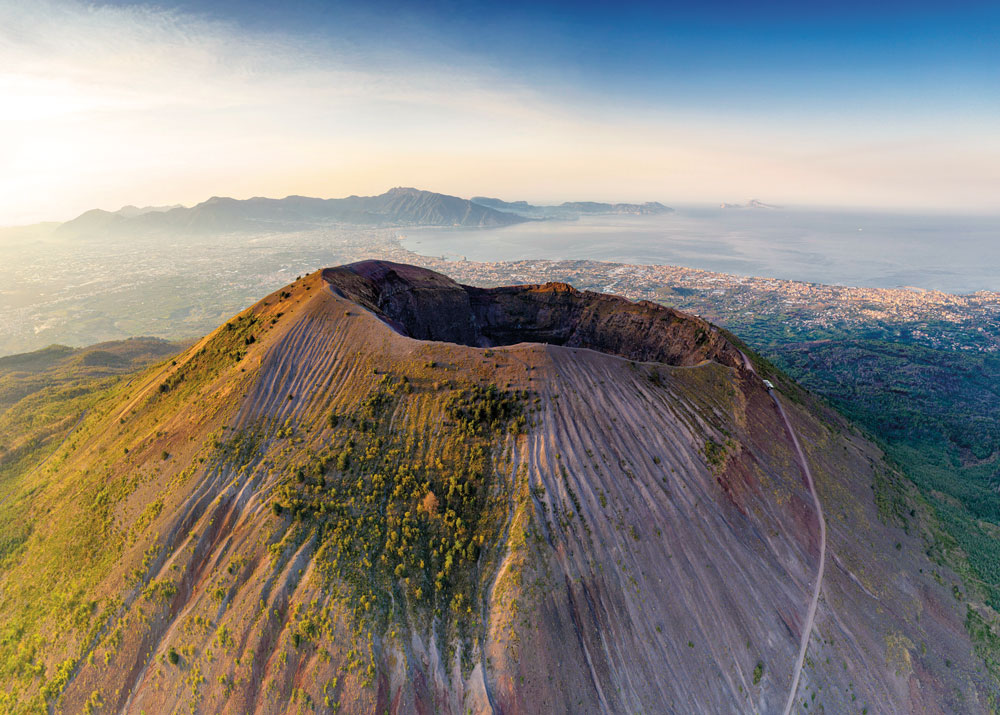
Aerial view of Mount Vesuvius crater and the Gulf of Naples at dawn.
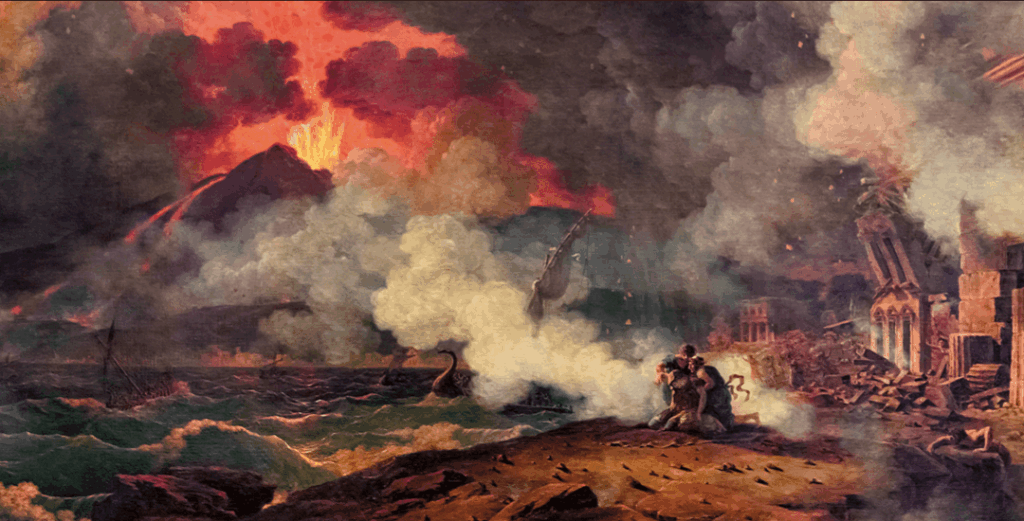
Depiction of the eruption of Mount Vesuvius by the painter Pierre-Henri de Valenciennes.
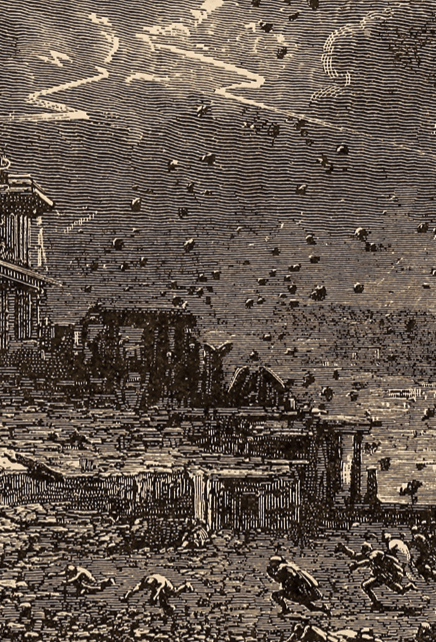
Engraving depicting the hailstorm of pumice stones over Pompeii.
GIUSEPPE FIORELLI AND THE BODIES OF POMPEII
GIUSEPPE FIORELLI AND THE BODIES OF POMPEII
Giuseppe Fiorelli, the most influential director of the Pompeii excavations, was also the archaeologist who perfected the technique for recovering the bodies found in the city. In February 1863, he conceived and promoted the technique of casts, based on the application of plaster casts in the cavities formed by the dissolution of the bodies themselves, essentially creating moulds. Wet ash was moulded tightly around the corpse, penetrating all facial cavities and clothing folds. As it solidified around the preserved flesh, it captured the impression of the body and encased the skeleton. By pouring liquid plaster into this mould, the features and gestures of the Pompeians who perished in the eruption would be faithfully replicated, portraying their final postures. The agony of animals was as painful as that of humans, as seen in the striking example of the house of Vesonius Primus (VI, 14, 20), where a dog tied with a chain in the atrium was petrified in its last, agonising attempt to break free. Each mould used to recover the bodies of people and animals connects us emotionally across time to the catastrophe and the moment when the life of a city was abruptly halted. Their sight compels us to empathise with the tragedy and the extraordinary impact of the disappearance of thousands of lives in a natural disaster of unparalleled violence and destruction in human history.
To date, nearly 400 bodies have been recovered under the pumice stone, and around 700 among the solidified remains of the volcano’s pyroclastic flow. Different investigations have not reached a consensus on the death toll, which would likely exceed 1,000 victims in any case. We’re discussing sensitive material with significant emotional power, bringing us closer, across time, to the catastrophe and helping us empathise with the extraordinary impact of the disappearance of thousands of lives in an unparalleled natural disaster. In 2022, researchers from the University of Copenhagen successfully sequenced the genome of a victim of the eruption, achieving the first successful sequencing of human DNA from an individual who perished. This allowed them to identify common gene groups from the island of Sardinia in the male victim, as well as to ascertain that he suffered from tuberculosis.
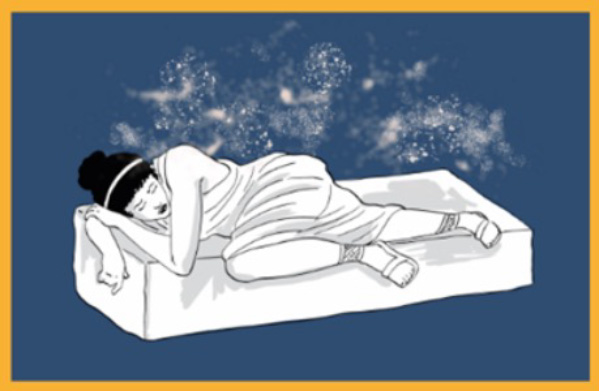
BURIED IN ASHES The victims of the eruption were covered in fine ashes that rained down over the city.
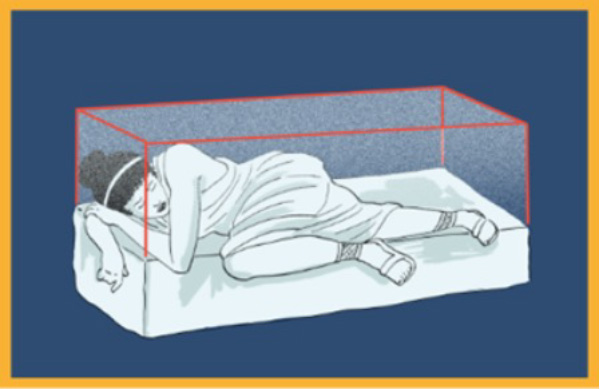
HARD SHELL The ash hardened to form a solid layer of porous pumice stone around each body.
DECOMPOSITION Over time, the soft tissue inside the shells decomposed and left cavity moulds.
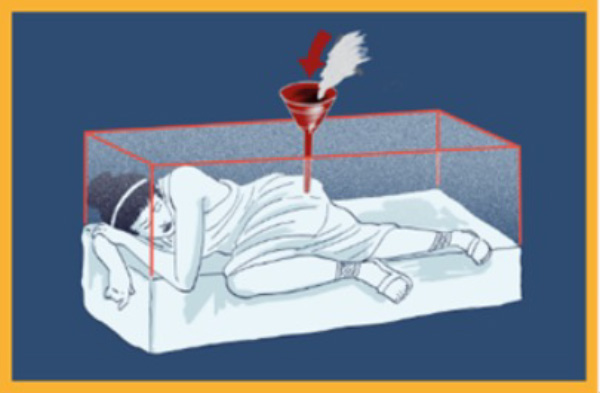
POURED PLASTER The archaeologists poured Paris plaster into the cavities and let it harden for a few days.
FINAL RESULT Once it had set, the outer pumice stone shells were cut to reveal detailed bodily moulds.
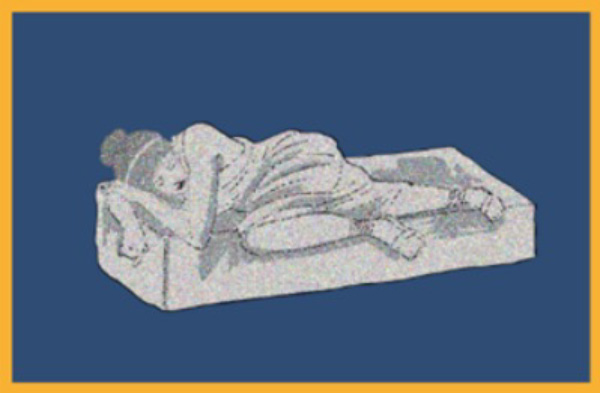
REPRODUCE REPLICAS The moulds were used to create more and more copies of the same person once the cavity was destroyed.
GRAFFITI IN POMPEII
GRAFFITI IN POMPEII
Graffiti were already part of everyday life in Roman times. Walls throughout the city became canvases where people left messages, drawings and opinions of every kind. In Pompeii alone, more than 10,000 graffiti have been uncovered, ranging from philosophical reflections and jokes to love notes, advertisements and political slogans—remarkably similar to the kinds of messages we still leave in public spaces today.
The extraordinary variety and originality of Pompeii’s graffiti make them an invaluable source for historians and archaeologists. They offer a rare glimpse into the daily lives, thoughts and personalities of ordinary Romans, revealing aspects of their society, culture and sense of humour that rarely appear in official historical records.
Some advertise businesses or promote political candidates, others declare loyalty to public figures, while many are so bold and expressive that they could easily be mistaken for contemporary street art.
Among them are countless witty remarks and memorable aphorisms, such as:
“Oh, wall, I’m surprised you haven’t collapsed yet, when you have to endure the tedious scribbling of so many writers.”
Admiror, paries, te non cecidisse ruinis, qui tot scriptorum taedia sustineas.
“A small problem becomes bigger if you ignore it.”
Minimum malu(m) fit contemnendo maximum.
Others are more personal, such as:
“Virgula to her friend Tertius: You are disgusting.”
Virgula Tertio suo indecens es
Experts on classical antiquity emphasise that the graffiti are remarkable evidence of the high level of literacy of the Roman population — many could read and write. They show us an expressive and open-minded people whose way of life still surprises us today.
Here you can see CIL 4.5296, a love poem that was discovered as graffiti on the wall of a corridor in Pompeii. The nine known verses read as follows (translation):
Oh, if only I could hold your little arms around my neck and kiss your tender little lips. Then go, little doll, entrust your happiness to the wind.
Believe me, human nature is fickle.
I have often lain awake, lost in the middle of the night, thinking to myself: many whom happiness has lifted up, those who have suddenly been flung away/abandoned and fall headlong, she then suppresses.
So too, after Venus has unexpectedly joined the bodies of lovers, daylight divides them and […].
O utinam liceat collo complexa tenere
braciola et teneris oscula ferre label(l)is
i nunc, ventis tua gaudia, pupula, crede
crede mihi levis est natura virorum
saepe ego cu(m) media vigilare(m) perdita nocte
haec mecum medita(n)s: multos Fortuna quos supstulit alte,
hos modo proiectos subito praecipitesque premit.
sic Venus ut subito coiunxit corpora amantum
dividit lux et se…
CREATE YOUR OWN GRAFFITI
The walls of Pompeii preserved the voices of ordinary people for nearly two thousand years. Now it’s your turn. Leave your mark on this collaborative mural and imagine an archaeologist discovering it centuries from now. What would you want to leave behind for posterity?
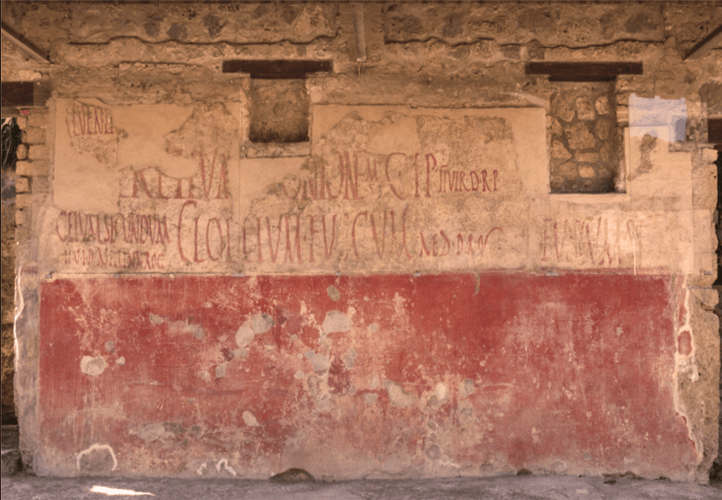
Fresco wall with Political Graffiti
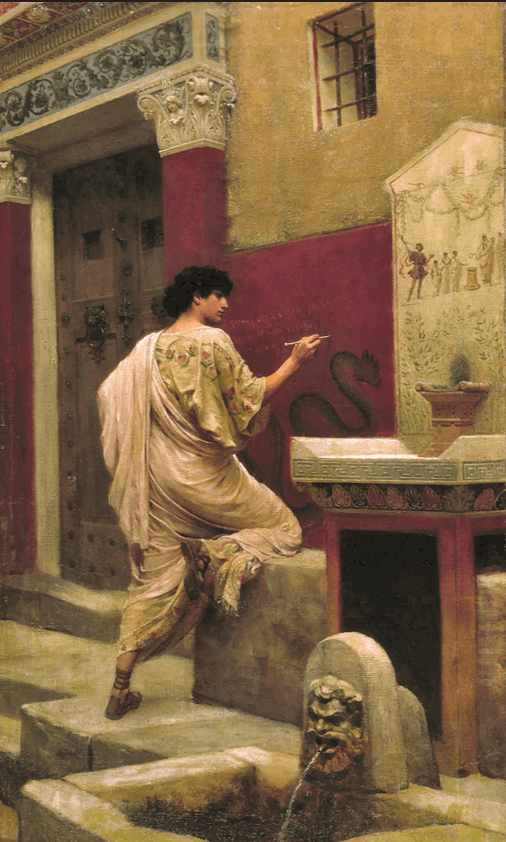
Painting by Władysław Bakalowicz, a 19th-century painter.
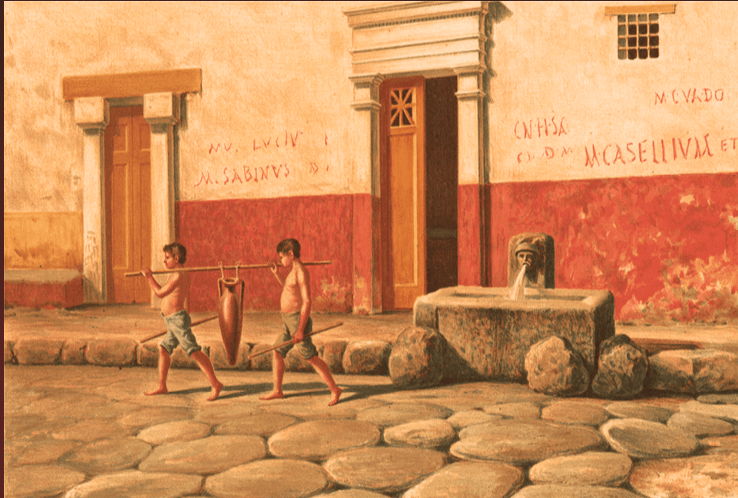
Escena de carrer amb la Font de Mercuri. Els murs apareixen coberts de grafitis, entre els quals trobem noms com M. Sabinus i M. Casellius.
Street scene with the Mercury Fountain. The walls are covered in graffiti, including names like M. Sabinus and M. Casellius.
INTERACTIVE OBJECTS
INTERACTIVE OBJECTS
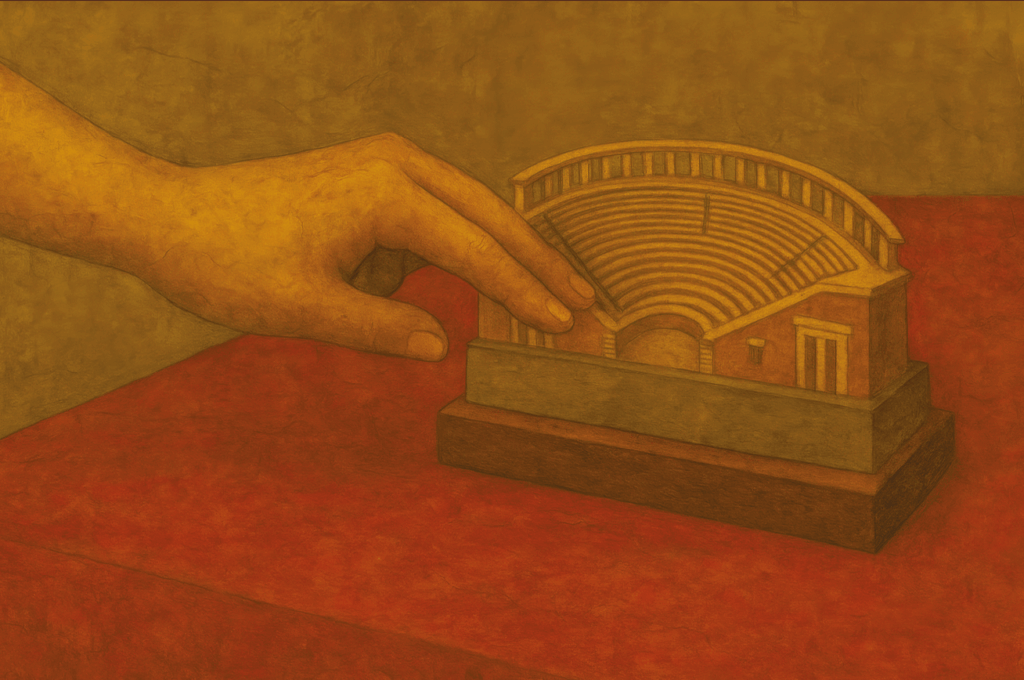
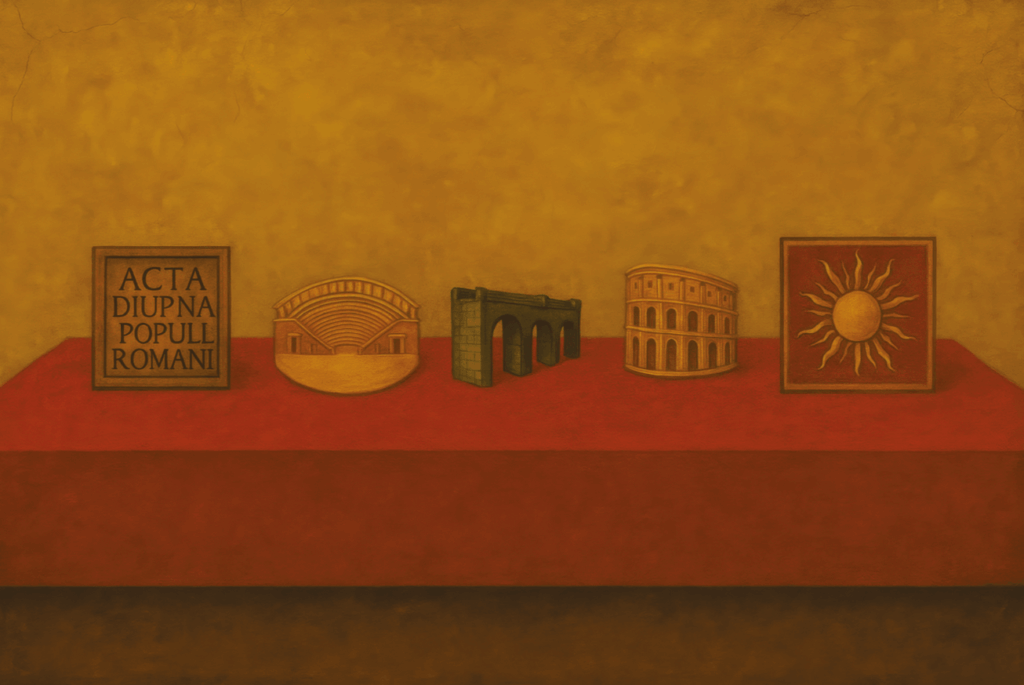
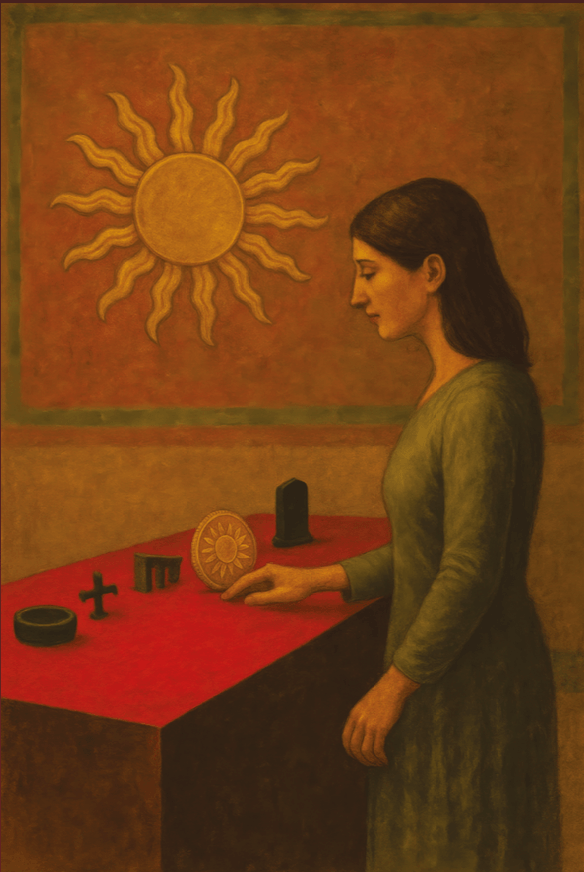
ROMAN INVENTIONS THAT SHAPED THE WORLD
Discover how the Romans shaped the world we live in – not just through cities and empires, but with ideas and inventions that still influence us daily. From books and stadiums to postal services, calendars, and roads, many modern essentials trace their origins back to Roman ingenuity.
This installation invites you to engage with interactive objects that bring these innovations to life. Touch an item to uncover its identity, its purpose in Roman times, and what it became the precursor of in our modern world.
There’s no set route – explore in any order you like, crafting your own story. Each object offers a glimpse into the extraordinary legacy of Roman innovation, revealing how ancient ingenuity still lives on in the structures, systems and habits that surround us today.
Acta Diurna Populi Romani
Roman Concrete (Opus Caementicium)
Amphitheatre
Codex
State Postal Service (Cursus Publicus)
Paved Roads
Insula (Apartment Building)
Lead Pipes (Fistulae Aquariae)
Surgical Instruments
Julian Calendar
- Roman invention: Daily news (Acta Diurna Populi Romani)
Long before social media, Julius Caesar set up the Acta Diurna: daily news carved or written on tablets placed in public spaces so that anyone could read it.
The texts were written by the diurnarii, early predecessors of journalists.
They included everything from Senate decrees to trials and even gossip.
For those who couldn’t read, the praeco —a kind of human loudspeaker— shouted the headlines around town.
The Acta Diurna was the ancestor of today’s press. But it was Gutenberg’s printing press, 1,400 years later, that made the same idea truly universal, enabling information to reach millions of people and making the news go viral —on paper.
- Roman invention: Roman concrete (Opus Caementicium)
Roman concrete was one of the Empire’s most brilliant achievements.
It was made from lime, volcanic ash, stones and water —a mixture so resistant that many Roman structures still stand today after 2,000 years!
Its secret? A mix of lime, volcanic ash, quicklime, pebbles, water and tiny limestone clasts. When cracks appeared, the lime reacted with water and sealed itself. Smart, right?
Today’s Portland cement owes its concept to the Roman formula —a new recipe, faster to produce, but not necessarily more durable.
Invented in 1824, it’s the material that keeps our buildings, bridges and skyscrapers standing tall.
Ask again in 2,000 years —we might just tie with the Romans.
- Roman invention: Amphitheatre
The Romans loved a good show —especially when it was loud, bloody and crowded.
The amphitheatre was their version of prime-time entertainment.
Its oval shape gave everyone the perfect view of the action and maximised seating capacity.
The one in Pompeii, built around 70 BC, is the oldest still standing —2,000 years later, still open for applause.
Modern stadiums and arenas keep the same idea: thousands of people sharing the thrill of a spectacle.
Today, these vast spaces have become urban icons of architecture and technology —temples of light, sound and emotion. Only now, the roar comes from fans, not lions.
- Roman invention: Manuscript book (Codex)
Before books, people used scrolls. Imagine trying to find page 87 on a 10-meter roll!
Romans simplified it with the codex: waxed wooden tablets bound together —the first “notebook”.
You could write, erase and tie several together. Students, merchants and officials all used them, long before paperback editions existed.
Gutenberg’s printing press gave the codex a turbo boost, but the books and publishing industry we know today stem from pure Roman genius —the first truly portable form of knowledge.
- Roman invention: Courier service (Cursus Publicus)
The Roman postal service was a marvel of organisation. Emperor Augustus created a network of stations along the great roads, with fresh horses (mutationes) and rest stops (mansiones) for couriers.
Messages could travel across the Empire at impressive speed — roughly 80 kilometres per day.
From that model came modern postal and logistics systems.
So yes, the next time your package arrives on time, thank the Emperor.
- Roman invention: Roman roads (Viae Romanae)
“All roads lead to Rome” was more than a saying —it was a strategy.
The Romans built an extraordinary network of paved roads connecting cities, ports and provinces across the Empire, allowing people, goods and ideas to move with unprecedented speed.
Constructed in several layers, they were built to last, with drainage systems that kept them solid for centuries.
These roads became the lifelines of an empire, carrying armies, trade and culture across continents —and many of them still lie beneath our wheels today.
Our highways and modern road networks follow the same logic: durable, direct and made to connect people —though traffic jams weren’t exactly a Roman problem.
- Roman invention: Apartment building (Insula)
Ancient Rome was a crowded place. The insula offered multi-storey housing for city dwellers, with several floors, small rooms and plenty of neighbours.
Shops and workshops filled the ground floor, while the poorer tenants lived upstairs. Fires and collapses were common, so living on the top floor wasn’t exactly a luxury.
Insulae were the ancestors of today’s apartment buildings.
Modern flats are much safer and better built, but the Roman insula introduced the very idea of vertical living for the masses.
It was the first step toward the dense, multi-storey cities we know today —a concept that still shapes how we live and share space.
- Roman invention: Lead pipes (Fistulae Aquariae)
Roman plumbing was a masterpiece.
Aqueducts brought water into cities, and lead pipes distributed it to fountains, baths and even private homes —a wonder of ancient engineering.
Too bad they didn’t know lead was toxic —luxury could literally make you sick!
Modern pipes use safer materials, but the Roman engineering idea remains the same: a pressurised network that keeps clean water flowing to everyone.
From ancient aqueducts to today’s vast urban systems, the principle of bringing water into our homes —and taking it safely away— is still one of humanity’s greatest achievements in public health and comfort.
- Roman invention: Surgical instruments
Roman doctors were surprisingly advanced. In Pompeii, archaeologists found scalpels, forceps and speculums almost identical to those used today.
They treated fractures, pulled teeth and even performed cataract surgery —with no anaesthesia! Brave patients indeed.
Many instruments we use today are refined versions of Roman prototypes, adapted with precision engineering and modern materials.
The main improvements? Stainless steel, sterilisation —and, thankfully, pain relief.
- Roman invention: Julian calendar
Before Julius Caesar’s reform, the Roman calendar was chaos —festivals popped up in the wrong season and nobody knew when to plant or harvest.
With astronomer Sosigenes of Alexandria, Caesar created a solar year of 365 days with a leap year every four. To reset the system, that first year lasted 445 days!
This reform finally aligned the calendar with the seasons, bringing order and stability to civic and religious life across the Empire.
Adopted in 1582 by Pope Gregory XIII, the Gregorian calendar refined Caesar’s Julian system to better match the solar cycle.
It’s the calendar we still use today —a legacy of Rome that continues to shape how the world measures time.
INTERACTIVE MAP
POMPEII BEFORE, DURING, AND AFTER THE ERUPTION
This immersive installation projects an interactive map of Pompeii, guiding visitors through three key moments in its history – from vibrant daily life to sudden destruction.
By moving through these three phases, the installation helps to imagine Pompeii as a living city, understand the force of the eruption, and to see how both came together to create a lasting legacy
Explore the city’s story in three phases:
- Pompeii Alive
The first map shows Pompeii as it was before the eruption of Mount Vesuvius, with bustling streets, homes, squares, and monuments – showing a thriving city full of life, rather than the ruins we see today.
- The Eruption Begins
Watch as the map shifts: small tremors shake the ground, and a dark cloud looms in the distance. Experience the mounting tension of the hours leading to Mount Vesuvius’s catastrophic eruption.
- Frozen in Time
Finally the volcano erupts, blanketing the city in ash and pumice, and marking the moment Pompeii was frozen in time. This stage reveals how a vibrant community was forever preserved beneath volcanic debris, becoming the archaeological wonder we know today.
- (Before) Amphitheatre RII
This is one of the oldest amphitheatres in the world, measuring 135 metres in length. With a capacity for 20,000 people, it hosted gladiatorial combats and other large-scale spectacles, becoming the epicentre of Pompeian leisure activities par excellence.
(After) House of Julia Felix (Praedia di Giulia Felice) RII
This spacious villa was the residence of an influential businesswoman in Pompeian society, Julia Felix. After the earthquake of 62 AD, she decided to convert part of her mansion into apartments available for rent and public spaces, such as thermal baths and luxurious gardens.
- (Before) Great Palaestra RII
An outdoor sports complex consisting of a large square plaza measuring 140 x 140 meters, which was used as an area for physical and intellectual training, as well as training for gladiators.
(After) Garum Warehouse RII
This small house was used to prepare ‘garum’, a product made from the maceration of fish and other small marine animals in salt, which was stored in numerous amphorae in the back garden. This popular sauce was exported to many parts of the Empire.
- (Before) The Thermopolium R VI
A small tavern open to the street, similar to a fast-food restaurant, with a bar or counter with jars containing hot food and drink to be consumed on the premises or taken away. There were more than a hundred of these taverns scattered throughout the city.
(After) House of the Tragic Poet with the Cave Canem mosaic R VI
This house retains its traditional form with an atrium where, at its main entrance, one of the city’s most famous mosaics can be found, depicting a dog and the text “Cave Canem”, which means “Beware of the dog”
- (Before) Villa of the Mysteries (Villa dei Misteri) RVI
A large villa located on the outskirts of the city, whose name comes from the famous frescoes it houses depicting the rites of worship of Dionysus, the god of wine.
(After) Necropolis of the Gate of Herculaneum
This necropolis stretches along the road leading to Naples and was already in use during the early centuries of the city’s existence. Here you can see monumental tombs of the most common types of the period.
- (Before) Stabian Baths (Terme Stabiane) RVII
These thermal baths were the oldest and largest in the city. Located in the heart of Pompeii, they were in the process of being enlarged when Vesuvius erupted in 79 AD.
(After) Eumachia Building RVII
This building, one of the most imposing in the Forum, was commissioned by Eumachia, a public priestess. This influential Roman matron was a businesswoman ahead of her time who, with her own money, built this architectural complex and dedicated it to Concordia Augusta.
- (Before) Basilica RVIII
The Basilica of Pompeii was a civil and commercial building, one of the most important and largest in the Forum. Initially conceived as a market and public meeting place, it evolved to be dedicated to commerce and the administration of justice.
(After) Imperial Villa RVIII
In this large, luxurious villa, a triclinium, or dining room, has been reconstructed with extraordinary frescoes, furniture and objects, an example of the reconstruction work being done in Pompeii where you can see evocative residences with domestic settings from everyday life.
- (Before) The Great Theatre RVIII
Built taking advantage of the natural slope of the hill for the construction of the auditorium, it has excellent acoustics. The theatre hosted theatrical performances, especially comedies and tragedies in the Greco-Roman tradition.
(After) Odeion RVIII
Built during the early years of the colony (79 BC), this building was dedicated to the most fashionable theatrical genre of the time, mime, or musical and singing performances. The structure had a functional roof to improve the acoustics.
- (Before) Temple of Apollo RVII
One of the oldest temples in the city, dedicated to one of the most popular deities. It was under reconstruction after the earthquake of 62 AD.
(After) Forum Granary RVII
These extend along the western side of the Forum with eight openings separated by brick pillars and served as a fruit and vegetable market. They are currently the city’s most important archaeological warehouse, housing more than 9,000 discoveries.
IA PHOTO BOOTH
Follow the steps
- Sit down with your face facing the front side of the photobooth screen.
- When the countdown starts, look at the camera of the photobooth.
- After a short moment, the portrait will be shown on the screen.
VR 360
VR Room Instructions:
- Take a seat.
- Put on a Virtual Reality headset.
- Turn your chair and enjoy.
- Raise your hand when you finish the experience so staff can remove your VR headset.
CLOTHING IN ANCIENT ROME
CLOTHING IN ANCIENT ROME
The Romans took their clothing very seriously: they slept in nightgowns and did not leave the house without first fixing their hair, shaving their beard or smoothing their clothes. The perfect donning of the toga (typical Roman outer garment over the tunic) was a daily ritual that required several specialised slaves.
Both men and women wore the tunic as an undergarment. It was the basic garment for every social class. There was only one difference in the tunic between the sexes: short-sleeved/sleeveless and knee-length for men, with short or long sleeves and reaching to the floor for women. Trousers were not usually worn at this time – except for the cavalry.
To keep warm in winter, the Romans wore various thicker woollen tunics, which could also be layered on top of each other. A cloak also helped against the cold. Over the tunic, citizens wore a toga, which expressed their social status as free citizens of the Roman Empire. The colour – usually white -, the fabric and the pattern showed the rank of the respective person: senators and knights had the right to wear a purple stripe on the hem of the toga. Married women usually wore a woollen cloak (stole) over their tunic, which was pulled over the back of the head like a veil on the street.
Putting the toga on correctly over the tunic was a complicated procedure, as this garment was in the shape of a semicircle with a diameter of three to six metres, which had to be skilfully wrapped and draped around the body.
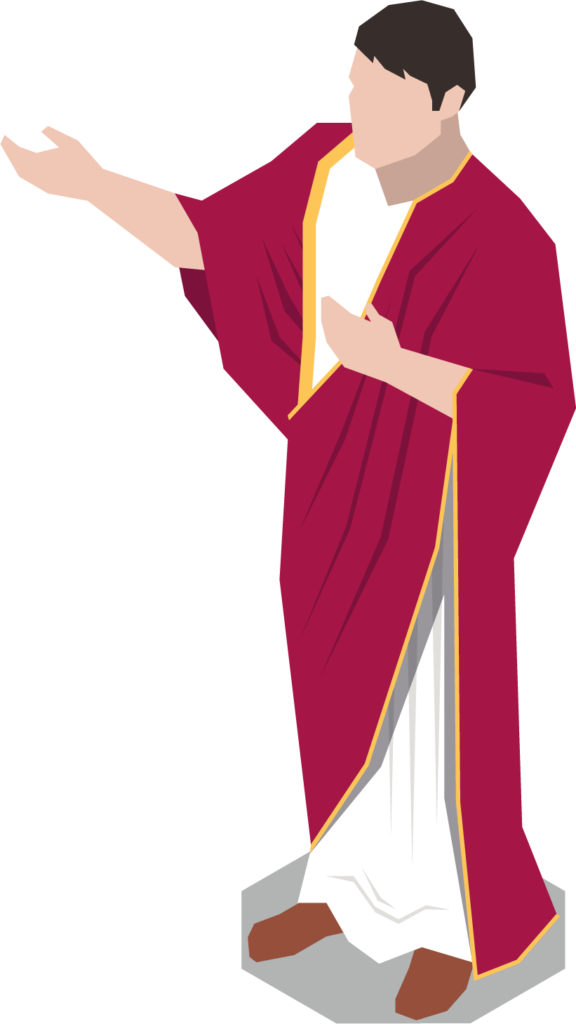
The tunic was of different lengths, short-sleeved or sleeveless. Wool tunics were worn in winter The toga was the most important piece of clothing. The colour - usually white -, the fabric and the pattern showed the rank of the respective person: senators and knights had the right to wear a purple stripe on the hem of the toga
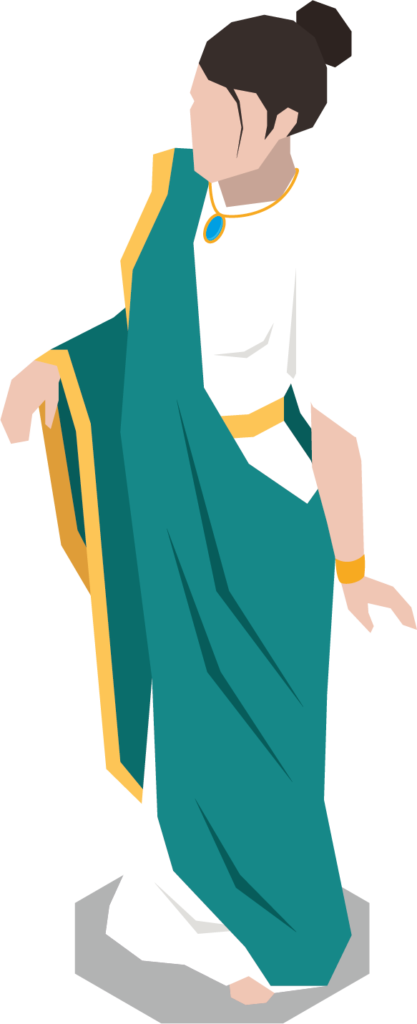
Elaborate hairstyles and expensive jewellery were often signs of high society. The tunic went down to the feet. Wool stoles were worn to show that a woman was married.
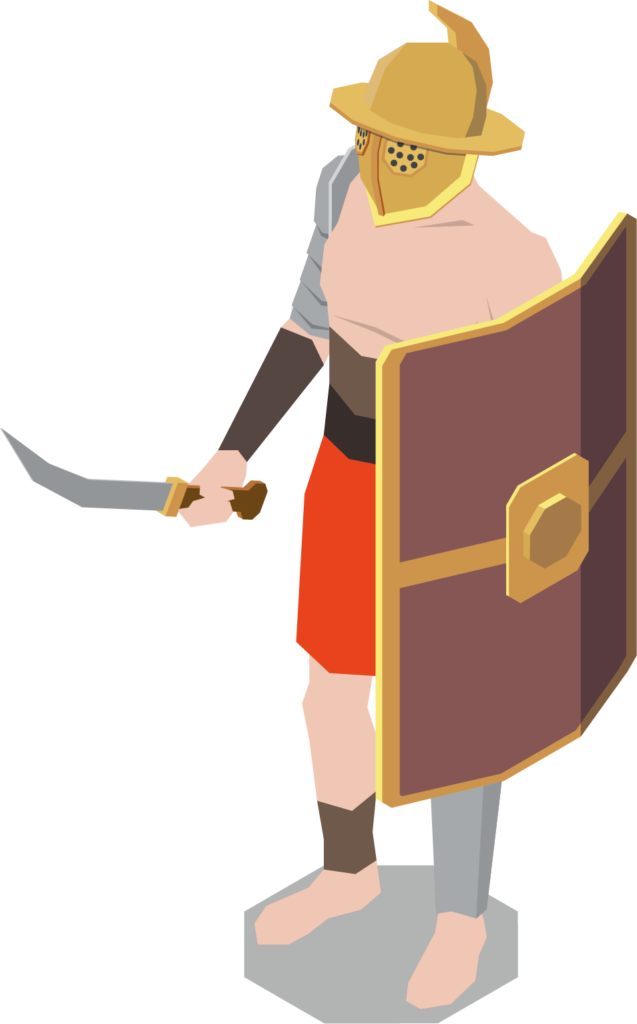
Gladiators usually fought without armour, but usually had a helmet and a shield. The right arm was protected by a "manica" - a thickly padded cloth sleeve. They wore metal greaves on their legs, which varied in height depending on the type of gladiator.
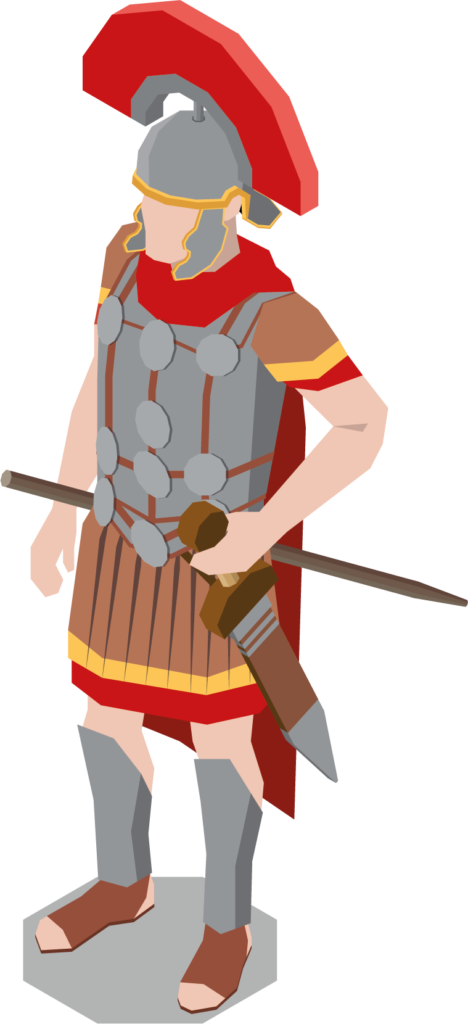
Soldiers wore plate armour or chain mail over their tunic. The belts were often decorated with elaborate metal plates. They had a large, rectangular shield and a short sword. Helmet, on which a plume could be pinned.
THE RENAISSANCE OF POMPEII
THE RENAISSANCE OF POMPEII
Pompeii was lost to memory for over 1,500 years. It is in the 18th century that it emerges from its ashes and captures the Europe of the time, seducing the world with its new forms and decoration.
The first contact with the buried city was in 1592, during the construction of the Sarno canal that had to cross the territory of Pompeii. The amphitheatre and the Temple of Isis near the forum came to light. A significant city had been discovered, but its name was still unknown, and the extent of the remains found was not yet understood.
The definitive discovery was in 1748 thanks to archaeological excavations promoted by Charles III of Spain, the King of Naples of the time. For this, he relied on the Spanish Roque Joaquín de Alcubierre, who had previously worked on various excavations in the area.
Alcubierre began exploration in the place known as La Civita, where valuable pieces from the ancient Roman world were continuously extracted. After a few years, a remarkable settlement was revealed with the discovery in 1763 of a complete inscription with the official title of the city “Res Publica Pompeianorum”: it was Pompeii, the ancient Roman city destined to become, over time, the symbol of the entire area destroyed by Vesuvius, thereby forever changing our understanding of the ancient world.
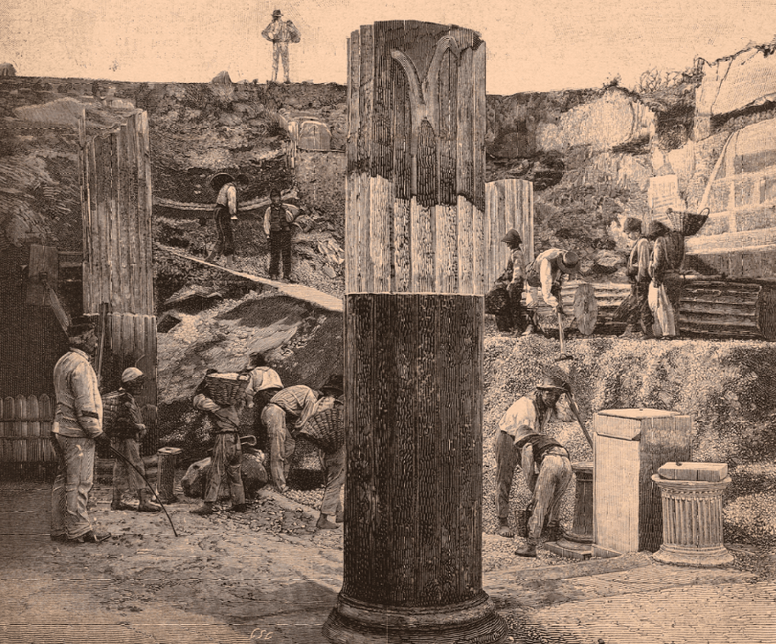
Interesting view of the elevation levels in the excavations of the buried city.
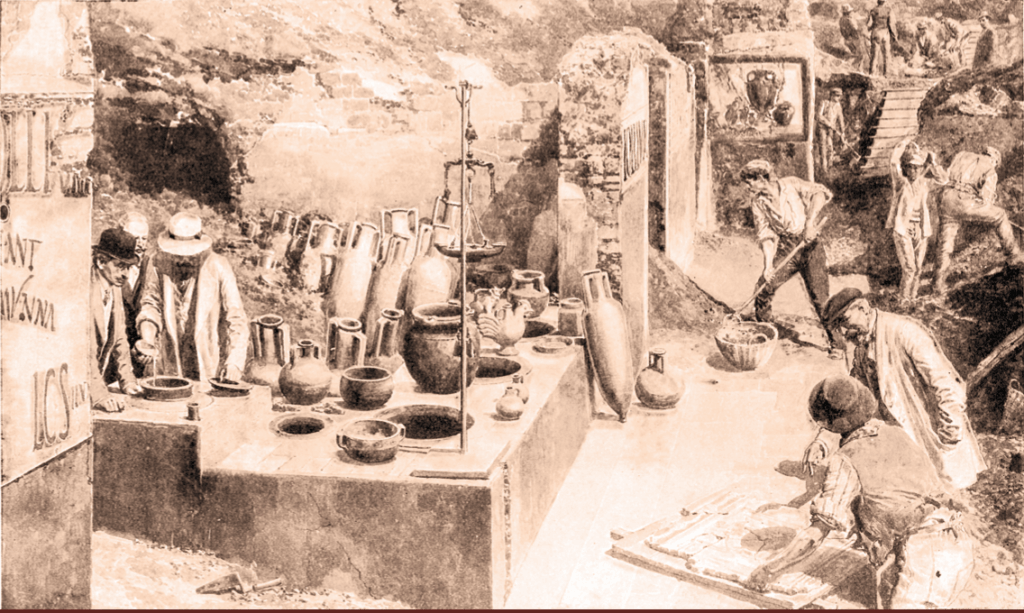
Discovery of a tavern in the city excavations, with all accessories and utensils intact.
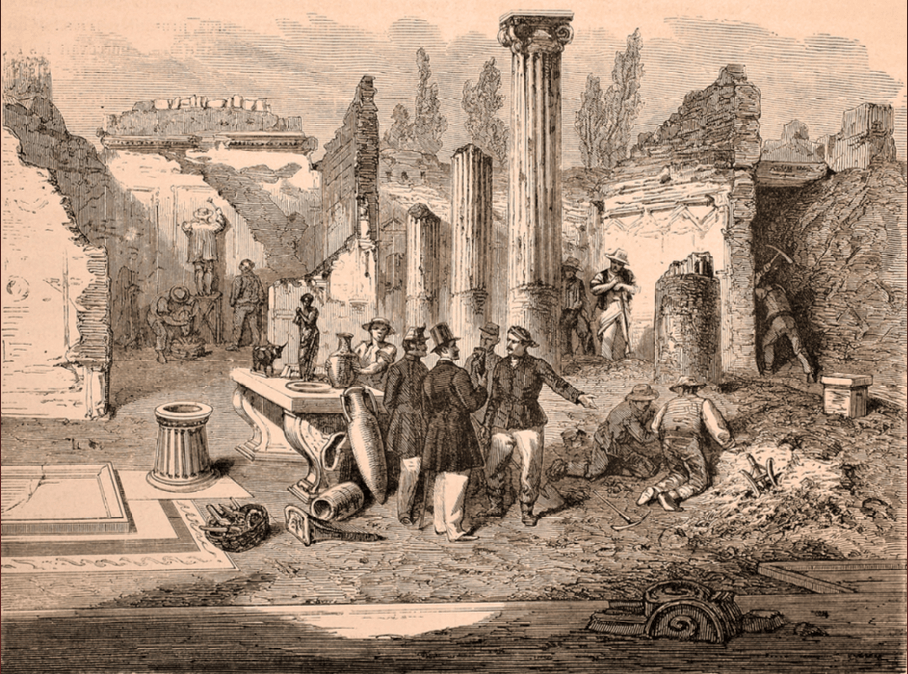
Excavations in Pompeii led by Giuseppe Fiorelli and his team.
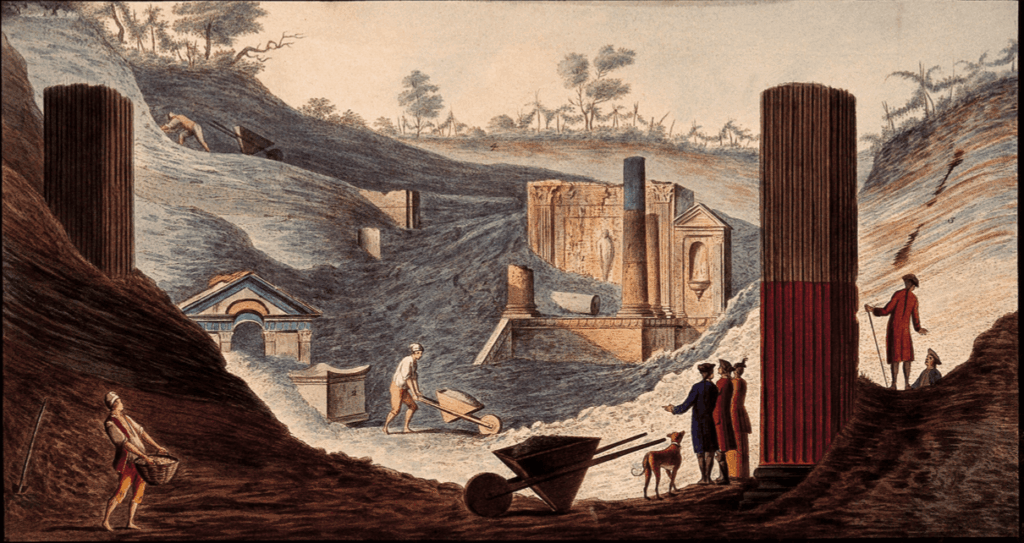
Discovery of the Temple of Isis under a layer of ash and volcanic material.
THE GRAND TOUR AND THE VISIT TO POMPEII
THE GRAND TOUR AND THE VISIT TO POMPEII
The travel experience of the Grand Tour was considered an essential form of education for young individuals from affluent European classes during the 18th century. It was driven by the empirical current, which advocated that knowledge originates from personal experience. This early manifestation of modern tourism was a way for aristocratic students, artists, and scientists to complete their education through a lengthy journey across Continental Europe, lasting for months or even years, and often carried an initiatory quality.
The journey through Italy typically concluded in Naples, which was the largest city in the country at that time, with the obligatory visit to the excavations of Pompeii. From the very beginning, Pompeii became the greatest archaeological attraction of its era. Impressions of the city were often influenced by prior readings, such as the immensely famous novel The Last Days of Pompeii published by Edward Bulwer-Lytton in 1834. This historical work was a key literary piece that immersed travellers in a passionate vision, allowing them to experience the splendour of the city with a thrilling account just moments before the tragedy. With its romantic style and a plethora of details about the golden city, it is considered by critics to be one of the essential classics of the ancient world and has served as an exciting inspiration for the current exhibition.
This travel itinerary to Pompeii, motivated by the variety of monuments and landscapes to be admired, has resulted in a multitude of writings, journals, and travel memoirs, as well as visual representations of the city. From watercolours, engravings, and illustrations from the 18th and 19th centuries to photos, postcards, and countless modern snapshots, the array of historical and contemporary images bear testimony to the profound allure that the ancient city of Pompeii exerted on the cultural formation of the travellers of that time.
THE VILLA OF MYSTERIES IN THE METAVERSE
The most famous villa in Pompeii opens its doors to us in the metaverse, allowing us to enjoy a journey where the past and present merge into an unparalleled experience. Transformed into digital avatars, we will walk through the rooms of the Villa of the Mysteries, revealing the splendour of its extraordinary architecture in times gone by. Thanks to cutting-edge technologies, we will visit 6 different rooms, such as its garden, atrium, courtyard, and even its famous triclinium. This space has gained fame thanks to the fresco decoration of one of the most beautiful pictorial programmes in the Vesuvius area, depicting a woman’s initiation into the Dionysian mysteries associated with the preparation of a bridal rite. We will bear witness to how technology, serving the experience by blending emotions and knowledge, invites us to fully immerse ourselves in the Pompeii experience.
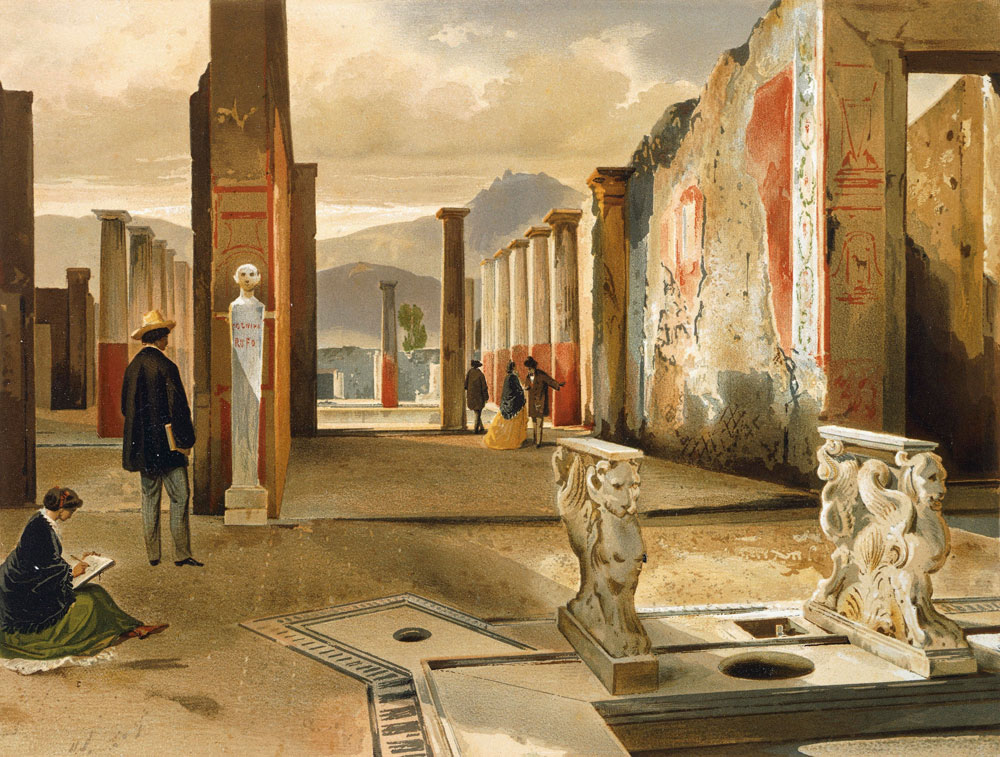
Vision of Pompeii by the brothers Fausto and Felice Niccolini in the 19th century.
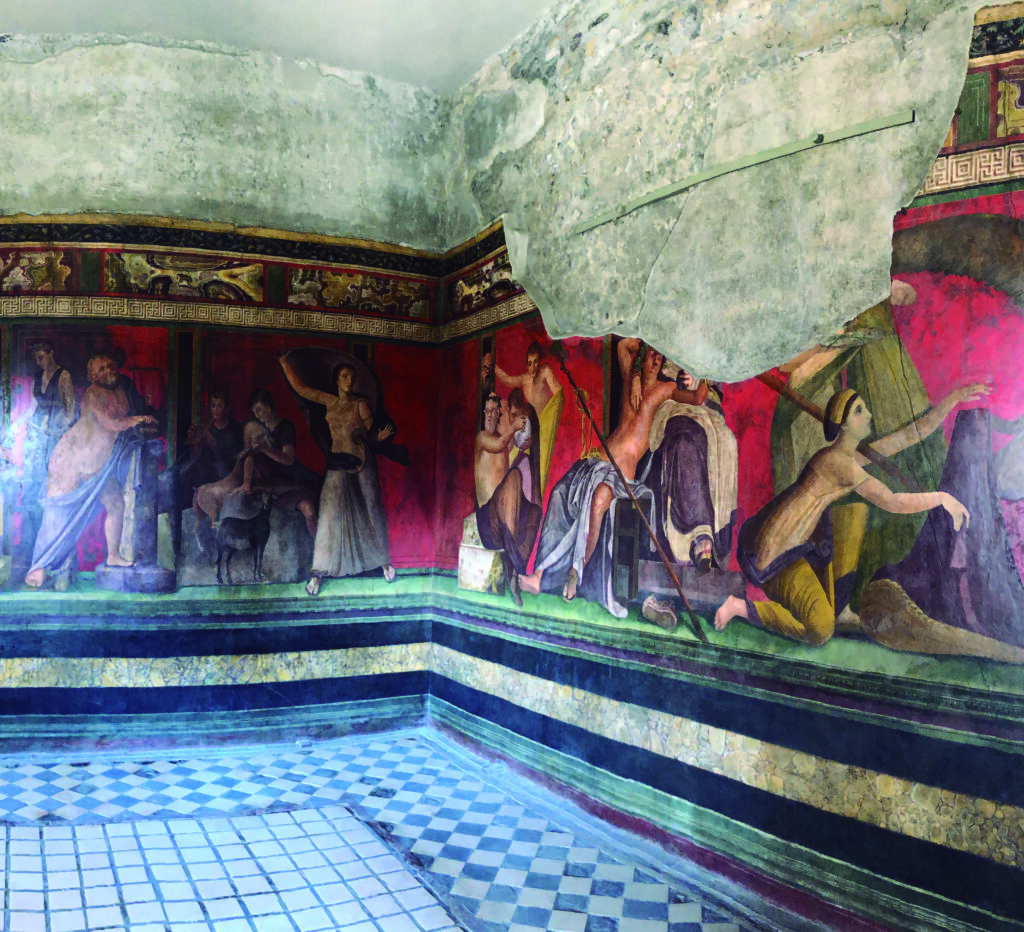
You are invited to one of the most impressive houses in Pompeii: The Villa of the Mysteries.
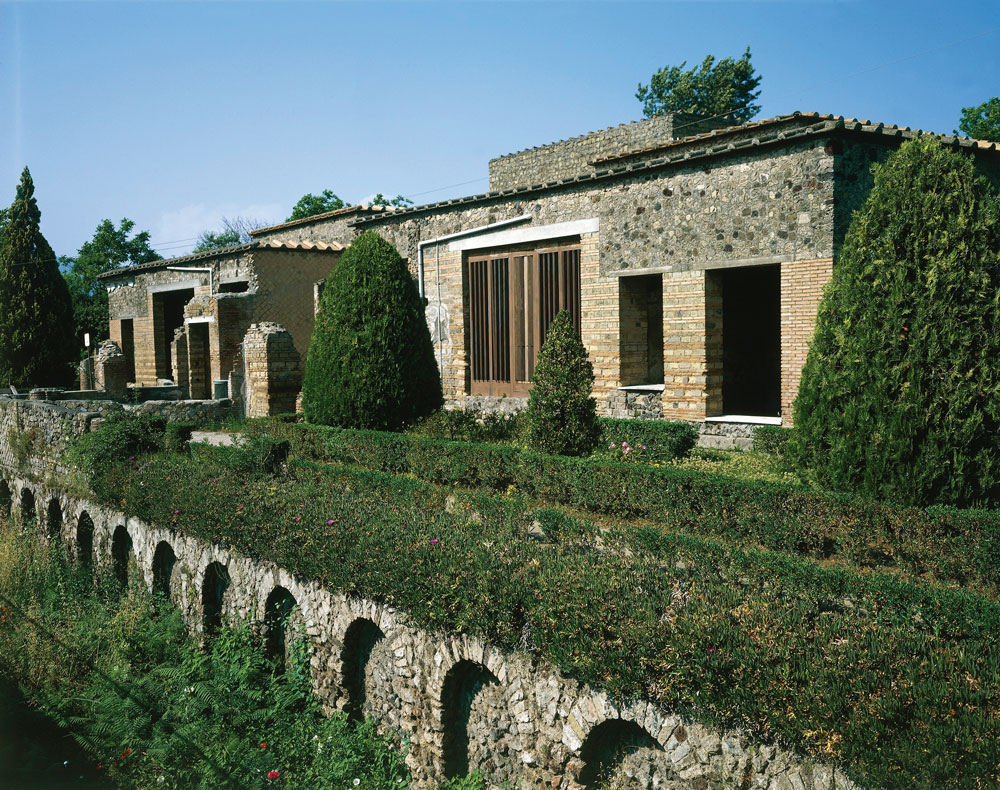
Enter its spacious grounds through the original path and admire the splendour of times gone by.
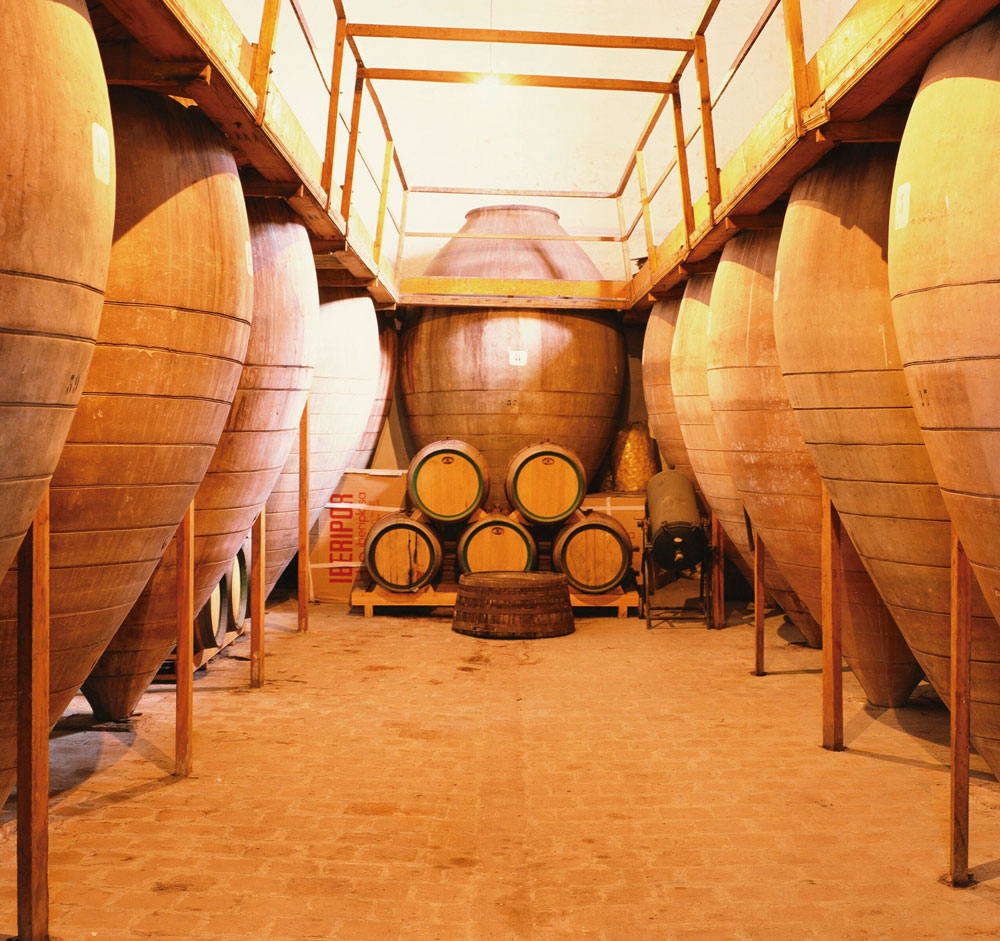
During this era, Pompeii was one of the epicentres of wine in the world, and many of these grand villas were its production centres.
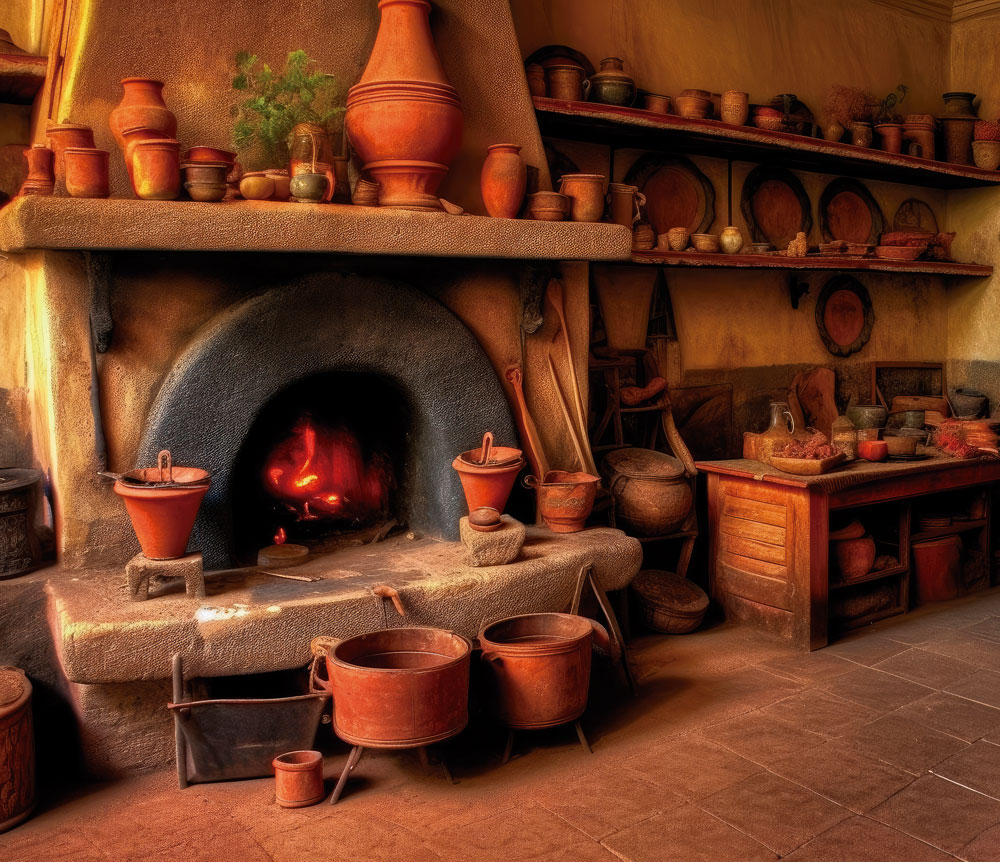
In the kitchen, one of the domestic fires or focus was located, always ready for food preparation, as well as the operation of a boiler, which heated water and provided heat to the bathing, toilet, and resting rooms.
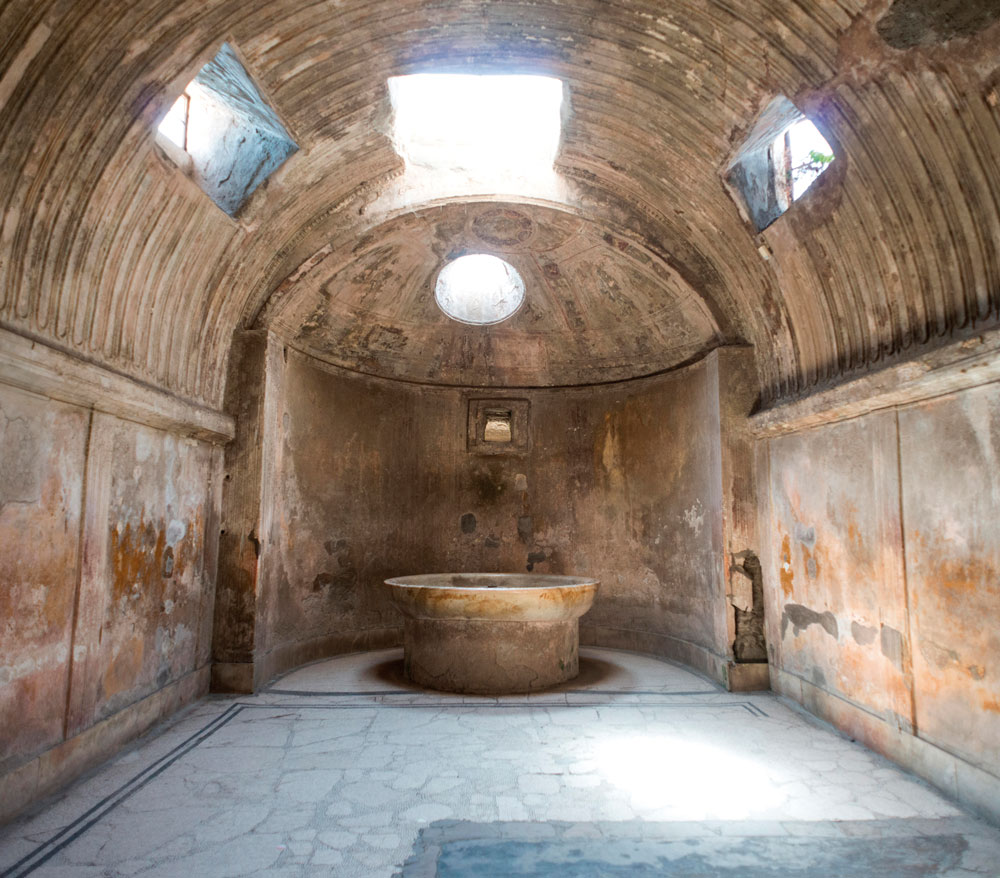
A social minority only had private bathrooms in their homes. In these, activities dedicated to rejuvenating the spirit took place, such as conversation, reading, and personal care.
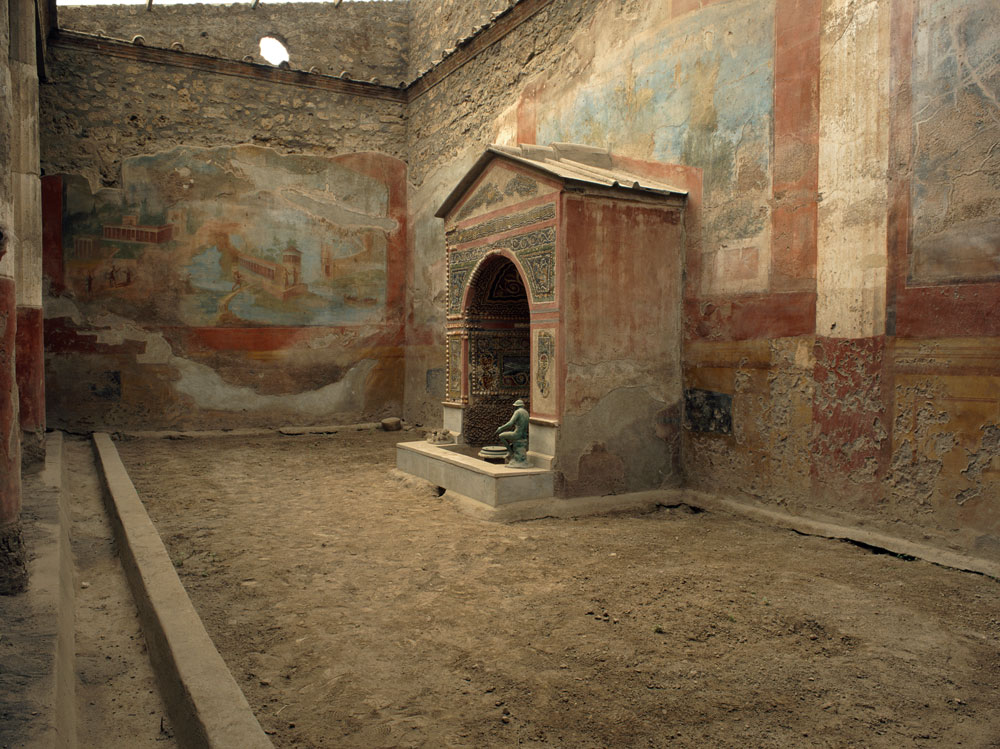
The domestic sanctuary was the sacred place in the house where prayers were offered up and offerings were made to the gods. It was very important for the home to be at peace with these deities responsible for protecting and watching over the family and the household.
METAVERSE
SAFETY RECOMMENDATIONS
You are about to enter a Virtual Reality experience.
Please be aware that the images you will see and the virtual environments you will navigate do NOT EXIST, so do not attempt to lean on them.
This is a free-moving, interactive, and collective experience where we encourage you to explore the interior of a Pompeii villa.
For your safety, it is important to pay attention to the following recommendations:
- Do not cross the boundaries of the virtual experience (walls, columns, barriers, and windows).
- Do not run, jump, or push anyone.
- If you feel dizzy or experience any loss of balance, raise your hand for assistance from the staff.
- If you encounter a technical issue with your Virtual Reality headset (the image goes black or it freezes, the virtual scene vibrates or moves too quickly), raise your hand for assistance from the staff.
- Children under 12 years old must be accompanied by an adult, holding their hands at all times.
- Keep quiet throughout the entire experience.
- Always follow our staff’s instructions.
- This is a guided tour, and you have 8 minutes to complete it. Please follow the audio and video instructions.
1st Room / Entrance path to the villa
Welcome to my villa. I am Licinia, Marco’s wife. We belong to a powerful family that lived in Pompeii. Come with me and enjoy the secrets hidden within our home.
Follow me towards the wineries, one of the most important areas of the production carried out on the farm.
2nd room / Cellars
We are in the cellars excavated in the basement of the so-called Pars Fructuaria. Huge wooden barrels and ceramic jars serve to store the god Bacchus’s favourite drink.
Please follow me to the kitchen.
3rd Room / Kitchen
Next to the fires we discover the kitchen, one of the most vital parts of the villa. The slaves work in this area of the house day and night so that everything is ready.
Now walk towards the thermal baths, one of my favourite areas of the Pars Urbana, the private area of the house.
4th Room / Bathrooms
After a day of work managing the town’s crops and livestock, we usually come to the hot springs to regain strength between pleasant hot and cold water baths.
Come with me outside, to the peristyle of the house.
5th Room / Peristyle
We are in the heart of our villa, the peristyle, the landscaped interior patio where nature has a special place represented with water, plants, animals; always surrounded by luxurious columns and colourful representations.
It’s time to return inside. Come with me to the last room, the chapel of the house.
Room 6 / Temple
This is where we remember our ancestors and dedicate our prayers to the Lares gods, the gods protecting our home.
Have you heard?! It could be a premonition of something terrible. I feel the breath of Neptune, god of earthquakes. I feel the fury of Vulcan, god of Fire. Run away, now that you can! Run to the bay! Save yourself!